


At the historic Gdansk Shipyard in Poland, an unusual industrial reality persists: crane operation is largely carried out by women.
Inside the massive production hall of the shipyard, where steel structures are assembled for ships and wind turbines, workers estimate that around 70% of crane operators are women — a legacy of labor organization dating back to the communist era.
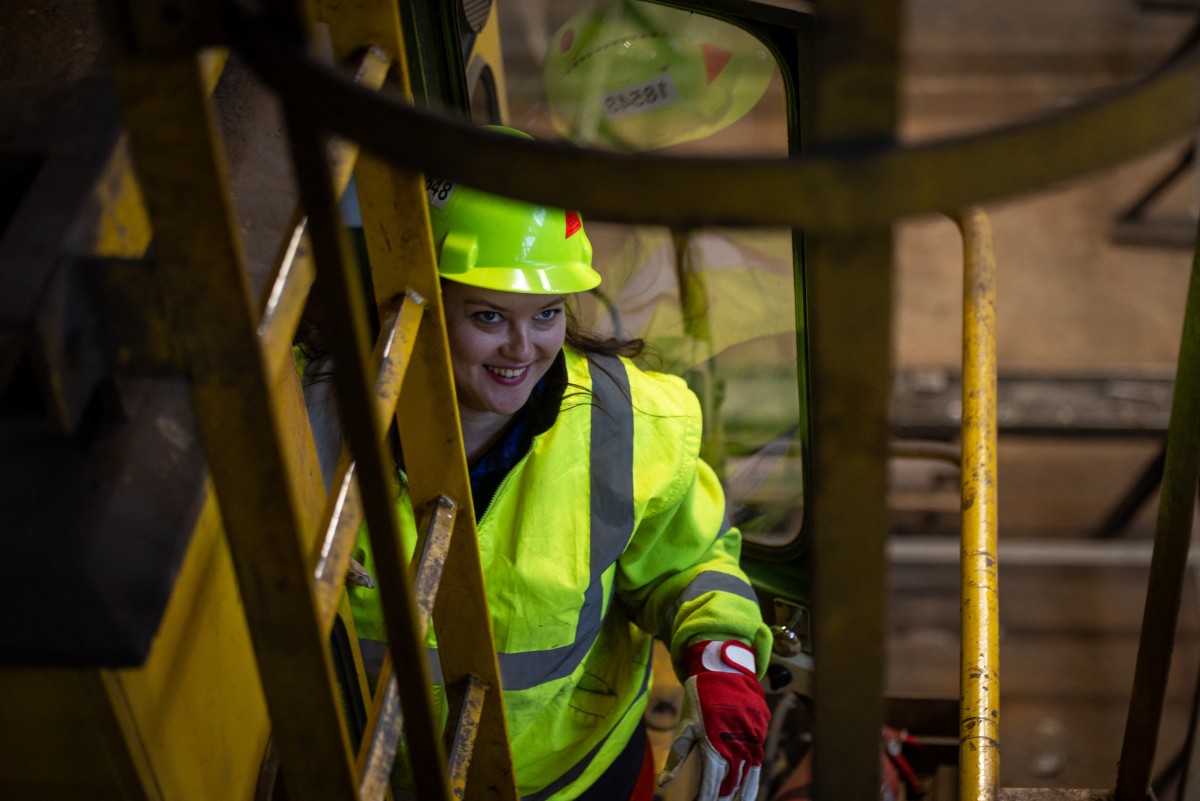
The photograph illustrating this article shows Nadia Bogomal, a 37-year-old Ukrainian overhead crane operator, climbing the ladder to the cabin of her crane inside the production hall of the Gdansk Shipyard.
From high above the workshop floor, Bogomal operates heavy lifting equipment that moves massive steel components used in shipbuilding and renewable energy infrastructure.
A legacy from the communist era
Every day, Halina Krauze, 65, climbs into the cabin of her overhead crane overlooking the vast industrial hall.
For nearly three decades, she has been responsible for moving large sections of steel that will eventually become ship hulls or wind turbine components.
From a height of around 15 meters, she supervises operations in a production hall spanning 6,500 square meters, one of the largest facilities of its kind in Central Europe. Below, hundreds of workers move between welding sparks, heavy machinery and the constant noise of industrial production.
According to Krauze, women make up the majority of crane operators at the shipyard today.
This situation reflects a longstanding tradition that began during Poland’s communist period.
Agnieszka Pyrzanowska, spokesperson for the Baltic Industrial Group, a state-owned company that took over parts of the shipyard after multiple economic restructurings, confirms this history.
Under the communist system, women were integrated into industrial jobs but were often assigned positions considered less physically demanding. Operating overhead cranes became one of those roles.
“It was a company where entire families worked,” Pyrzanowska explains, reflecting the strong community ties historically associated with the shipyard.
A site shaped by history
The Gdansk Shipyard occupies a unique place in European history.
It was here that the Solidarity trade union movement was born in 1980, following strikes triggered by the dismissal of Anna Walentynowicz, a crane operator and activist whose case sparked nationwide protests against the communist regime.
For Krauze, Walentynowicz remains a powerful symbol.
“She was a kind of legend, especially for the older generation,” she says.
Krauze herself joined the shipyard in 1983, when it was still called the Vladimir Lenin Shipyard. Over the years, she has witnessed the dramatic transformation of the site.
“Back then we built about ten ships per year,” she recalls.
“Today we build dozens of wind turbine towers every year. It’s completely different.”
Passing skills to a new generation
Today, experienced crane operators also play a key role in training new workers.
Among them is Lesia Kovaltchouk, a 48-year-old Ukrainian crane operator who fled to Poland after Russia’s full-scale invasion of Ukraine in 2022.
After more than fifteen years working as a crane operator in Ukraine, she now trains apprentices at the Gdansk shipyard.
For her, the job requires extreme precision and responsibility.
“Below you there are people working,” she explains. “You have to be careful so nothing happens, so there is no tragedy.”
Kovaltchouk notes that in several Eastern European countries, women operating cranes is not unusual.
“In Ukraine, it is completely normal that crane operators are women. Nobody is surprised.”
Industrial heritage and changing times
On the International Women’s Day, Halina Krauze reflects on how working life has evolved over the decades.
She recalls small symbolic gestures that once marked the celebration of women workers during the communist era — stockings, chocolates or carnations distributed at the factory.
Today, she says, those traditions have largely disappeared.
“Now there is nothing,” she says. “Trade unions often forget about women.”
Despite these changes, the presence of women operating cranes high above the production floor remains one of the most distinctive features of the Gdansk Shipyard, where industrial history, political transformation and the energy transition continue to intersect.
Voici un paragraphe additionnel en anglais, que tu peux insérer dans l’article (après la partie sur le métier par exemple). Il élargit au métier de crane operator, compare avec la France et ouvre sur les métiers techniques femmes-hommes.
A technical profession still largely male-dominated in Europe
Operating an overhead crane is a highly skilled technical profession that requires precision, spatial awareness and strict attention to safety. Crane operators are responsible for lifting and moving heavy industrial components—sometimes weighing several tons—while coordinating closely with workers on the ground. Any error can lead to serious accidents, making concentration and experience essential.
Despite the technical expertise required, the profession remains largely male-dominated in many European countries. In France, for example, women represent only a small minority of crane operators and construction machinery operators, a trend that reflects the broader gender imbalance across technical and industrial trades. According to labor market data, women remain significantly underrepresented in sectors such as construction, mechanical engineering and heavy industry.
This imbalance extends to many STEM and technical professions, where cultural stereotypes, lack of role models and workplace conditions have historically limited women’s participation. Yet examples like the Gdansk shipyard demonstrate that these jobs are not inherently gendered. Where training opportunities and workplace cultures allow it, women can—and do—occupy highly technical roles traditionally associated with men.
As industries across Europe face labor shortages and the need for new technical skills, increasing women’s participation in industrial and engineering professions is increasingly seen as both an economic necessity and a question of gender equality.