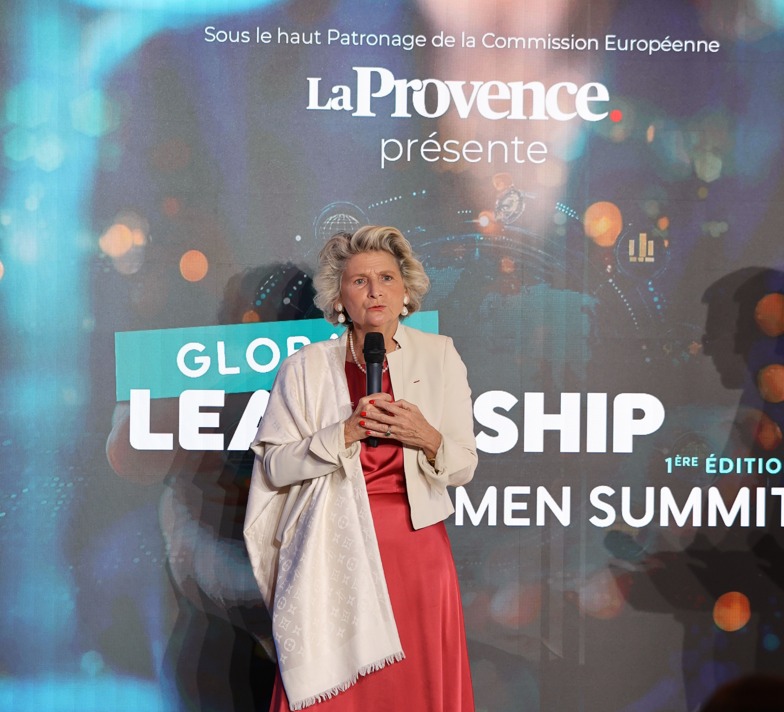


Partner of the Global Leadership by Women Summit 2026, The Women’s Voices speaks with Chiara Corazza, Special Advisor to the Summit, France Representative to G20 EMPOWER, former member of the G7 Gender Equality Advisory Council, and President of the Women Economic Forum Europe. In this exclusive interview, she shares her vision of global leadership, women’s participation in decision-making, and the governance models needed to address today’s geopolitical, economic, technological and societal challenges.
You advocate for Global Leadership by Women rather than leadership for women. What concrete changes in governance would you like to see emerge over the next five years?
Just one week ago, Abelardo de la Espriella was elected President of Colombia. Among his stated priorities are a policy of mano dura (iron-fist law and order), deforestation, and, despite looking carefully, I found little evidence that social progress or gender equality are part of his agenda. He joins the ranks of Javier Milei and Nayib Bukele in Latin America, and more broadly the group of powerful leaders who govern through force, personal ambition and unilateral decision-making.
Is this really the direction we want the world to take?
Can we continue allowing five men to decide our future, the future of our planet, the way artificial intelligence is governed, how we invest and trade, whether nations go to war or remain at peace, and ultimately our collective security?
As Giuliano da Empoli so accurately writes, “this is the age of predators.” But for how much longer?
It is now up to all of us to respond and to reinvent a model of governance centred on people, the common good and the public interest.
Women, alongside men, must fully exercise leadership and decision-making responsibilities in every field.
Over the next five years, I hope to see the emergence of a more balanced, fairer and more visionary model of governance, where diversity of talent becomes a genuine driver of competitiveness, innovation and performance.
Women contribute just as much as men to creativity, innovation, organisational resilience and peacebuilding. Their leadership is not an issue affecting women alone—it is a collective project for our societies and our economies.
Studies estimate that advancing women’s leadership could generate more than 28 trillion dollars in additional global economic value.
The challenge before us is therefore to transform the culture of power itself and, together, build a leadership model capable of addressing the defining challenges of our time.
This year’s Summit brings together political leaders, business executives, international organisations and media representatives. How can this diversity become measurable action rather than simply another forum for dialogue?
This year, alongside French Ministers Aurore Bergé, Roland Lescure and Sabrina Roubache, the Summit will bring together leaders from some of the world’s most influential women’s networks operating across all five continents, including Women in Tech Global, G100, Women Economic Forum, Arab International Women’s Forum and 100 Women @ Davos.
The programme also includes representatives from major international institutions, reflecting a shared ambition to advance a global movement for Global Leadership by Women.
I also wanted the Global Leadership by Women Summit, supported by CMA CGM, for which I oversee both the editorial vision and international strategy, to become fully aligned with the priorities of the French G7 Presidency.
Receiving the Summit’s official G7 label represents an important recognition of that shared ambition.
The Summit will contribute to France’s key priorities by promoting stronger international partnerships based on cooperation and solidarity, reducing global economic imbalances and advancing a more balanced and sustainable model of prosperity.
We are committed to turning ideas into measurable action.
The partners supporting the Global Leadership by Women Summit are visionary leaders who are already driving meaningful change within their organisations and across their industries. They include Tanya Saadé Zeenny (CMA CGM), Christine Fabresse (Caisse d’Epargne CEPAC), Coline Pont (Accor), Marie Guillemot (KPMG), Carine Kraus (Carrefour), Marc-André Kamel (Bain & Company) and Émilie de Lombarès (Onet).
Far more than another international conference on women’s leadership, the Summit has been designed as a platform for mobilisation, cooperation and long-term impact. The discussions, recommendations and calls to action developed throughout the event are intended to inform not only the agendas of the G7 and G20, but also the work of major multilateral institutions shaping tomorrow’s global governance.
As a strategic Euro-Mediterranean gateway connecting Europe, Africa and the Middle East, Marseille provides a unique setting for building international coalitions capable of generating lasting impact on territories, businesses, institutions and global decision-making.
The Summit addresses topics ranging from artificial intelligence to geopolitics. Why is it essential for women to be represented in the sectors shaping the world’s balance of power?
At a time when 85% of today’s jobs will be transformed, ensuring equal access to the skills that will define tomorrow’s economy has become a strategic imperative.
Today, women represent only just over one-third of graduates in science, technology, engineering and mathematics, despite the fact that these disciplines underpin the industries, technological sovereignty and economic competitiveness of the future.
Investing in women’s education, leadership development and access to executive decision-making is therefore not simply a matter of equality. It is an investment in our collective capacity to innovate, accelerate the green and digital transitions, strengthen economic resilience and develop sustainable solutions that serve the public interest.
I would like to acknowledge the remarkable work carried out by Angélique Gérard, Angela Naser and Sandrine Richard, whose commitment is helping prepare a new generation of women leaders in technology and innovation.
The sectors shaping global power dynamics will ultimately determine our collective future.
Artificial intelligence, climate action, finance, international trade, infrastructure, energy, healthcare and diplomacy are redefining geopolitical influence, technological leadership and economic sovereignty across the world.
Women have a central role to play in each of these strategic sectors.
Their participation strengthens innovation capacity, improves the quality of decision-making and reinforces the resilience of organisations facing unprecedented global transformation.
Research consistently demonstrates that organisations with more balanced leadership outperform others in terms of innovation, creativity, long-term performance and their ability to anticipate emerging challenges.
The 2026 Global Leadership by Women Summit reflects this conviction.
Among this year’s flagship themes is Technology Diplomacy, an emerging discipline that is rapidly reshaping international governance. The Summit will showcase pioneering initiatives led by the Tech Diplomacy Global Institute, founded by Ayumi Moore Aoki in partnership with UNESCO, with the ambition of developing new international frameworks for cooperation, trust and responsible governance in the fields of digital technologies and artificial intelligence.
Women’s leadership in diplomacy, security, emerging technologies and innovation has become one of the defining strategic challenges of the twenty-first century.
Beyond gender equality, it represents a powerful catalyst for economic transformation, technological progress, international competitiveness and sustainable development.
More broadly, women’s rights, investment in skills and the ability to think beyond short-term political cycles remain fundamentally linked to the quality, resilience and legitimacy of collective decision-making.
At a time when gender equality policies are being challenged in several countries, how can we convince decision-makers that women’s leadership is not only a matter of rights, but also a strategic issue for competitiveness, security and global stability?
Today, we are witnessing the erosion of fundamental rights in many parts of the world, alongside the rise of anti-rights movements that threaten decades of progress for women and girls.
As illustrated by the testimonies of Zarifa Ghafari, Fahimeh Robiolle and Catherine Ladousse, whether in Afghanistan, Iran or within digital ecosystems where algorithmic bias and disinformation amplify existing inequalities, vigilance and collective action have never been more essential.
Governments, businesses, international organisations and civil society all share a common responsibility to guarantee the effective and lasting protection of women’s and girls’ rights.
Yet this is not solely a democratic or human rights imperative.
It is also one of the defining economic and geopolitical challenges of our time.
Societies that recognise, develop and mobilise the full spectrum of talent strengthen their capacity for innovation, improve their economic competitiveness and become more resilient in the face of profound technological, environmental and demographic transitions.
Women represent an extraordinary engine of entrepreneurship, value creation, sustainable growth and long-term prosperity for businesses, territories and national economies alike.
Women’s leadership also contributes directly to international stability and peace, as demonstrated by the work of Donia Kaouach and Patricia Elias.
When women participate fully in political decision-making, diplomacy, peace negotiations and governance, responses to crises become more cohesive, more inclusive and more sustainable.
Trust grows stronger, institutions become more resilient and public policies are better equipped to anticipate long-term challenges rather than simply reacting to immediate crises.
Safeguarding our democratic values, strengthening economic sovereignty and building resilient societies require us to mobilise every available talent, every perspective and every source of expertise.
This is precisely the ambition behind the Global Leadership by Women Manifesto.
Its objective is to promote a model of governance that is balanced, responsible, inclusive and value-creating—one in which women fully participate in shaping strategic decisions, driving innovation, leading economic and technological transitions and advancing the common good.
Global Leadership by Women is not a project for women alone.
It is a new model of leadership for governments, businesses and international institutions seeking to navigate an increasingly complex, uncertain and interconnected world.
Together, we have a collective responsibility to ensure that the future is imagined, designed and built by women and men alike.
Only through truly inclusive leadership will we be able to create stronger democracies, more competitive economies, more resilient societies and a more peaceful world.