



With the Artemis II mission, Christina Koch will become the first woman to take part in a crewed lunar mission—an historic milestone that reshapes the narrative of space exploration.
More than fifty years after the Apollo program, humanity is preparing to return to the Moon. But this new phase of exploration does more than extend a legacy—it challenges the very foundations on which that legacy was built.
Artemis II, a roughly ten-day circumlunar mission, marks the first step in NASA’s broader ambition to establish a sustained human presence beyond low Earth orbit. On board, an American astronaut is set to make history: Christina Koch.
For the first time, a woman will be part of a crewed mission around the Moon. Long treated as incidental, this absence now appears for what it truly was: a significant blind spot in the history of space exploration.
Christina Koch: A Career Defined by Scientific Excellence
Christina Koch’s place on this mission is not the result of symbolic representation, but of a career built on scientific rigor and operational expertise.
Selected by NASA in 2013, she quickly distinguished herself through her ability to operate in extreme environments. Even before becoming an astronaut, she had worked in conditions closely resembling those of space, particularly in Antarctica, where isolation and survival constraints provide a unique training ground.
Her mission aboard the International Space Station marked a turning point. In 2019, she set a record with 328 consecutive days in space, the longest continuous spaceflight ever achieved by a woman. She also took part, alongside Jessica Meir, in the first all-female spacewalk—an event that exposed long-standing structural biases, including in the design of space equipment itself.
According to NASA, her career reflects a rare combination of technical excellence, physical endurance, and adaptability in extreme conditions—qualities essential for lunar missions and future journeys to Mars.
From Individual Achievement to a Shift in Narrative
While Christina Koch’s presence on Artemis II is a historic milestone, it also signals a deeper transformation: a shift in the narrative of space exploration.
From the iconic images of Earth rising above the lunar horizon during Apollo 8 to the first Moon landings, lunar exploration has long been embodied by male figures. These images shaped collective imagination, influencing both scientific aspirations and perceptions of progress.
The absence of women was not merely statistical. It reflected a cultural framework in which certain trajectories appeared natural, while others remained unthinkable.
With Artemis II, that framework begins to fracture. For the first time, the presence of a woman on a lunar mission is no longer exceptional—it becomes operationally normal.
A Strategic Evolution for NASA and the Space Sector
This shift comes at a time when space exploration itself is undergoing a profound transformation. Space is no longer just a stage for symbolic competition between global powers; it has become a strategic domain at the intersection of economic, scientific, and geopolitical interests.
The Artemis program aims to establish a sustainable human presence on the Moon, develop new orbital infrastructures, and pave the way for crewed missions to Mars. In this context, diversity is no longer a secondary issue—it is a factor of performance.
NASA itself emphasizes that long-duration, complex missions require teams capable of integrating diverse experiences, skills, and ways of thinking. Christina Koch’s presence reflects a broader structural evolution in astronaut recruitment and training.
A Direct Impact on Scientific Aspirations
The significance of this moment also lies in its upstream effects. Space exploration has always been a powerful driver of inspiration for future generations.
For decades, the figures associated with the Moon were exclusively male. This homogeneity, often implicitly, limited how young girls could project themselves into scientific and technological careers.
Christina Koch’s participation in a lunar mission changes that equation. It is not just symbolic—it provides tangible proof that the most demanding scientific paths are open to all.
A Mission at the Heart of a New Era
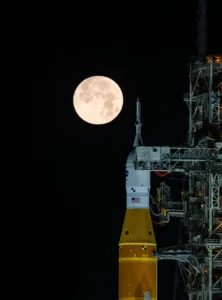
Artemis II will conduct a circumlunar flight without landing, testing the Orion spacecraft’s systems and the conditions required for human life beyond low Earth orbit.
It is a critical step ahead of Artemis III, which aims to return humans to the lunar surface.
Within this new cycle of exploration, Christina Koch represents a transition: from a history shaped by exclusion to a more inclusive—and more relevant—model of exploration.
A Story Finally Being Rewritten
She will be joined on the mission by Reid Wiseman, Victor Glover, and Jeremy Hansen.
But for the first time, the story of the Moon will no longer be told without women.
And what should have been self-evident decades ago is, at last, becoming reality.