


In 2025, conflicts across the world once again revealed a stark and persistent reality: women are disproportionately exposed to violence during wars, political crises and humanitarian disasters. Whether as civilians, caregivers, combat medics, activists or hostages, women’s bodies and lives remain deeply entangled with the dynamics of armed conflict and systemic violence.
This photo retrospective highlights some of the most striking images of the year, capturing the many faces of women confronted with violence — but also their resilience, courage and political presence in times of crisis.
Beyond the immediacy of these images lies a broader truth: gender-based violence in conflict is not accidental. It is structural, strategic and deeply rooted in power relations.
Symbolic gestures in a violent world
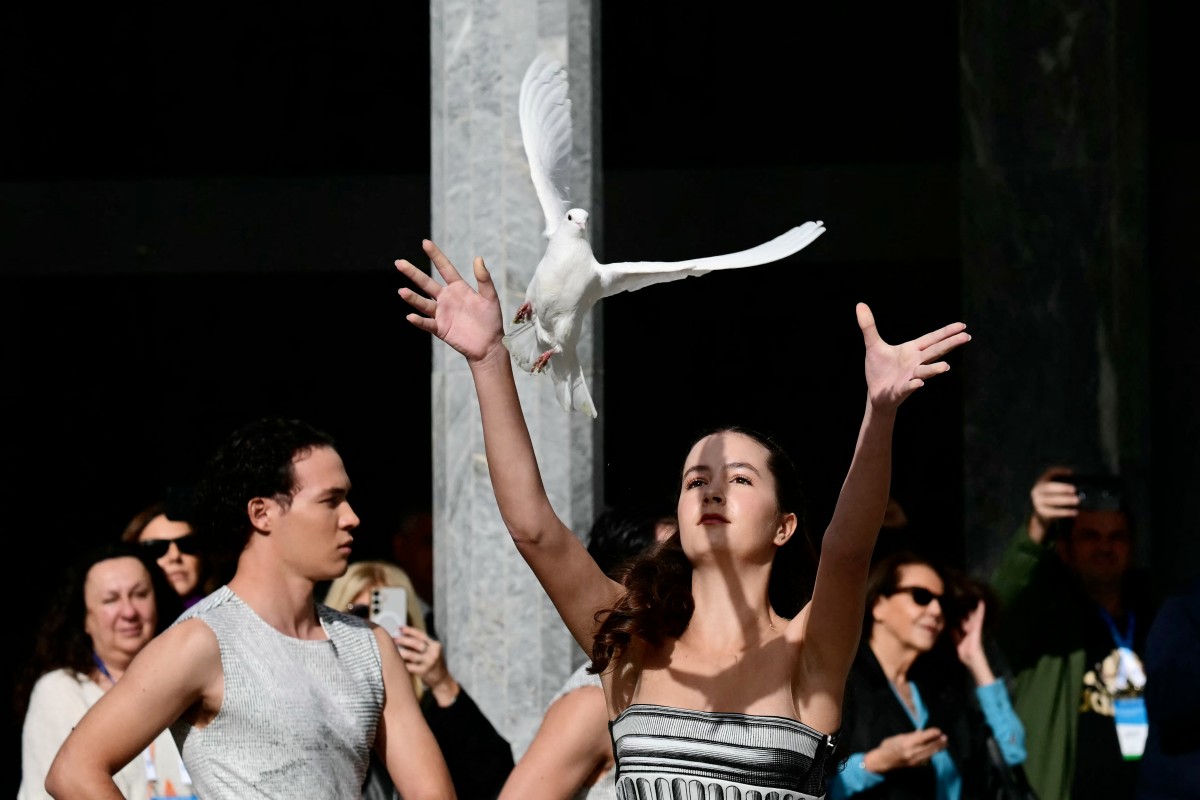
One of the most striking images of 2025 shows an actress releasing a dove during the Olympic flame lighting ceremony for the Milano Cortina 2026 Winter Games, in Olympia. At first glance, the image appears serene, almost timeless. Yet placed alongside scenes of war and destruction, it becomes deeply symbolic.
Peace is often performed through women’s bodies and gestures, while violence is inflicted upon them elsewhere. This contrast reflects a long-standing paradox: women are frequently used as symbols of peace, nationhood or hope, while being excluded from decision-making processes that lead to war.
Women as caregivers on the battlefield
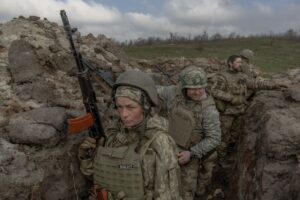
In eastern Ukraine, Natalia, a 51-year-old mother of three, serves as a combat medic in the 24th Mechanized Brigade amid the Russian invasion. Her presence on the front line reflects a broader transformation of modern warfare, where women increasingly take on critical roles traditionally dominated by men.
Yet this visibility comes at a cost. Female medical personnel face not only physical danger but also heightened risks of sexual violence, psychological trauma and long-term health consequences. Their contribution remains under-recognized, even as they sustain entire military and civilian systems through care and survival work.
Civilian women trapped under the rubble
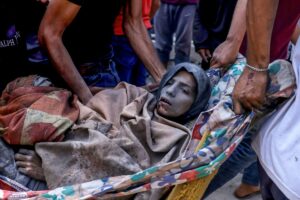
In Gaza, images of injured Palestinian women pulled from the rubble after airstrikes are among the most harrowing of the year. These scenes underscore how civilian women bear the brunt of military operations in densely populated areas.
Displacement, injury, loss of family members and lack of access to healthcare disproportionately affect women, particularly pregnant women, elderly women and those caring for children. International humanitarian law formally protects civilians, yet women’s suffering in war zones remains largely normalized and insufficiently documented.
Hostages, visibility and gendered violence
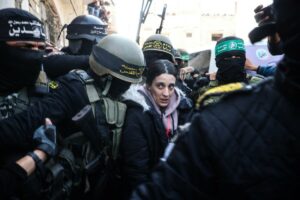
Another defining image of 2025 shows Israeli hostage Arbel Yehud being escorted during a hostage-prisoner exchange in Gaza. Hostage-taking is not gender-neutral. Women hostages face specific threats, including sexual violence, coercion and long-term psychological harm.
At the same time, their visibility often becomes politicized, instrumentalized by all sides of a conflict. Women’s captivity becomes a tool of communication, propaganda and negotiation, reinforcing the idea that women’s bodies are strategic terrain in war.
Fighting femicide beyond war zones
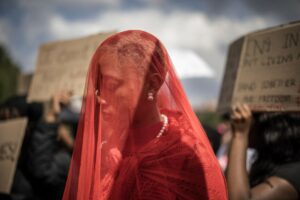
Violence against women is not confined to active war zones. In Pretoria, South Africa, activist Khumo Maake participated in a demonstration calling for gender-based violence and femicide to be declared a national disaster.
This image reminds us that conflict exists on a continuum. Structural violence, patriarchy and impunity create conditions where women are unsafe both in times of war and in so-called peacetime. Feminicide, domestic violence and sexual assault are part of the same global system of domination.
Women’s bodies as battlegrounds
Across all these images runs a common thread: women’s bodies are repeatedly used as battlegrounds — physically, symbolically and politically. Rape as a weapon of war, forced displacement, deprivation of healthcare, and silencing of women’s voices remain widespread despite international commitments.
According to UN data, conflicts dramatically increase rates of sexual violence, maternal mortality and economic precarity for women. Yet accountability mechanisms remain weak, and survivors often face stigma rather than justice.
Photojournalism plays a crucial role in documenting these realities. Images create archives of violence, but also of resistance. They force societies to confront uncomfortable truths and challenge narratives that erase women from the history of conflict.
These photographs are not only records of suffering; they are calls to action. They demand stronger international accountability, feminist foreign policies, survivor-centered justice and the inclusion of women in peace processes. In a world saturated with visuals, these images stand out because they refuse to look away. They remind us that behind every statistic is a woman with a name, a life and a story.