
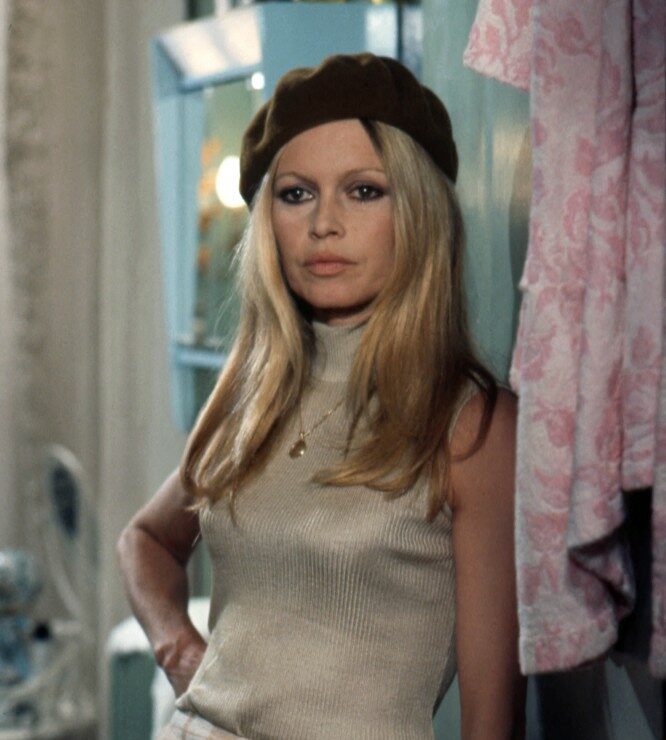


The End of an Era. Brigitte Bardot has died at the age of 91, in her home La Madrague in Saint-Tropez. A global star of French cinema, the ultimate icon of the 1950s–1960s, and later a radical figure in animal rights advocacy, Bardot spanned the twentieth century, leaving an indelible mark on popular culture, the image of women, and the relationship between fame and commitment.
The Brigitte Bardot Foundation announced “with immense sadness” the death of its founder and president, recalling her decision to abandon an extraordinary artistic career to devote her life to the protection of animals.
A Meteoric Rise and a Cultural Earthquake
Born on September 28, 1934, in Paris, Brigitte Anne-Marie Bardot first trained in classical dance before being discovered by cinema at a very young age. But it was in 1956, with And God Created Woman by Roger Vadim, that she became a worldwide phenomenon. The film shocked, fascinated, divided—and propelled Bardot into myth.
It inaugurated a new representation of femininity on screen: free, sensual, unbound by traditional moral codes. Bardot did not merely play a role; she became a symbol—a woman who neither apologized for her desire nor her independence.
In less than twenty years, she appeared in nearly fifty films, imposing a magnetic presence that far exceeded the confines of French cinema.
The Films That Forged the Bardot Legend
Brigitte Bardot’s career is studded with now-cult classics, among them:
- La Parisienne (1957)
- The Truth (La Vérité, 1960) by Henri-Georges Clouzot, which earned her the David di Donatello for Best Foreign Actress
- A Very Private Affair (Vie privée, 1962) by Louis Malle
- Contempt (Le Mépris, 1963) by Jean-Luc Godard, whose opening nude monologue—enumerating parts of her body—entered film history
- Viva Maria! (1965), opposite Jeanne Moreau
Two scenes remain etched in collective memory: the incendiary mambo in a Saint-Tropez restaurant (And God Created Woman) and the opening of Contempt. These images forged a global icon, often compared to Marilyn Monroe, yet marked by a European singularity—intellectual, unsettling, unmistakable.
An Icon Beyond the Screen
Bardot was more than her films. She profoundly influenced fashion, behavior, and the collective imagination: ballet flats, Breton stripes, gingham prints, loose hair. She helped shape the legend of Saint-Tropez—and that of Búzios in Brazil, which became an international resort after her visit.
A singer as well, she recorded more than sixty songs, notably with Serge Gainsbourg, including Harley Davidson and Bonnie and Clyde. She embodied a woman claimed—sometimes defiantly—as free: “a woman who needs no one.”
A Radical Renunciation of Fame
In 1973, at just 39, Brigitte Bardot made a radical decision: she left cinema for good. No comeback, no farewell tour, no retrospective. She turned the page on a world she deemed violent, intrusive, and incompatible with her values.
The withdrawal marked a rare rupture in the history of the star system. Where others prolonged their myth, Bardot chose erasure—only to redirect her energy elsewhere.
Animal Rights: A Lifelong Fight
From the 1970s onward, Bardot devoted her life to animal protection. In 1986, she founded the Brigitte Bardot Foundation, recognized as a public-interest organization and now a major player in animal welfare in France and internationally.
Her battles were many:
- denouncing animal cruelty
- opposing animal experimentation
- fighting certain slaughter practices
- defending wildlife
She leveraged her fame for these causes—sometimes with blunt, confrontational methods that drew both fervent support and sharp criticism.
A Controversial, Politically Divisive Figure
The later decades of Bardot’s life were also marked by controversial political and ideological positions. Her statements on immigration, feminism, and hunting led to several court convictions for racial insult.
She openly claimed affinity with Marine Le Pen and the Rassemblement National, arguing that the right represented “the only remedy” to France’s decline. In her book Mon BBcédaire, published in October by Fayard, she wrote:
“FREEDOM IS BEING YOURSELF, EVEN WHEN IT DISTURBS.”
Over the years, Brigitte Bardot’s public standing was profoundly reshaped by a series of judicial convictions for racist and hate-inciting statements. Between 1997 and 2019, she was convicted multiple times by French courts for incitement to racial hatred, public insult, and defamation on the basis of origin or religion—offences defined under France’s 1881 Law on Freedom of the Press.
Her convictions stemmed primarily from open letters, press interviews and opinion columns in which she targeted Muslim communities, immigration, and religious practices, notably ritual slaughter.
A Life Withdrawn, Far from the World
In recent years, Bardot lived between La Madrague and La Garrigue, two properties in Saint-Tropez, surrounded by animals. She chose a deliberately withdrawn, almost ascetic life.
In a May interview with BFMTV, she said she sought above all “peace and nature,” describing herself as living “like a farmer,” among sheep, goats, pigs, a donkey, a pony, dogs, and cats.
Hospitalized in Toulon in the autumn for surgery, she had reassured the public about her health, urging “everyone to calm down.”
An Immense, Irreducible Legacy
Brigitte Bardot leaves behind a towering legacy. She was:
- a mythical actress of French cinema
- a global icon of popular culture
- a pioneer of bodily liberation on screen
- an uncompromising advocate for animal rights
- a divisive figure—sometimes troubling, never consensual
The end of a myth.