

At the 79th Cannes Film Festival, the 11th edition of the Positive Cinema Week once again positioned cinema as a space for reflection on some of today’s most pressing social, cultural and environmental issues. Created by Jacques Attali and Sam Bobino, the initiative celebrates films and artists capable of “changing the way we look at the world” through stories that inspire awareness, inclusion and social progress.
The Belgian filmmaker was honored for a deeply human film exploring masculinity, vulnerability and freedom during World War I
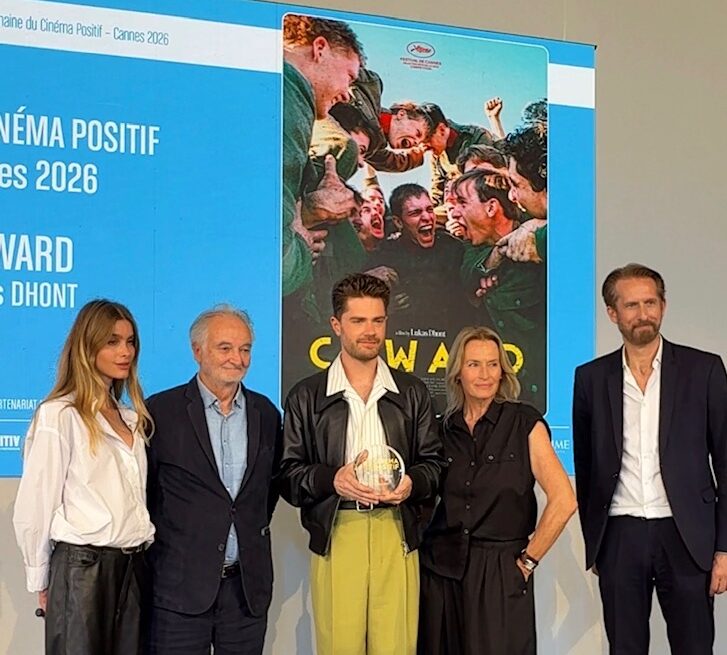
One of the highlights of this year’s edition was the Positive Cinema Award 2026 presented to Belgian director Lukas Dhont for his new feature film Coward, screened in Official Competition at Cannes.
The award was presented on May 22 on the CNC beach in Cannes by Jacques Attali, founder and president of the Positive Cinema Week, alongside Estelle Lefébure, patron of this 2026 edition, and Sam Bobino, co-founder and general director of the event.
Coward: a film about humanity in the midst of war
With Coward, Lukas Dhont continues his exploration of emotional vulnerability, masculinity and human intimacy — themes already central to his acclaimed films Girl and Close.
Set during World War I, Coward follows two young soldiers trying to preserve their humanity, sensitivity and ability to love in the midst of violence and destruction. Through this intimate story, Dhont contrasts art, tenderness and emotional connection with the brutality of war.
The film questions traditional ideas of courage and masculinity, offering instead a vision of resistance rooted in empathy, fragility and emotional survival. It is precisely this deeply human perspective that resonated with the values of the Positive Cinema Award, which honors films contributing to social awareness and collective reflection.
Already recognized at Cannes in 2018 for Girl, Lukas Dhont confirms with Coward the singularity of a cinematic voice that is both delicate and profoundly universal.
A week focused on inclusion, storytelling and cultural transformation
Media partner of this year’s edition, The Women’s Voices took part in several discussions dedicated to the transformations shaping contemporary cinema and the audiovisual industry.
Among the key conversations was the panel:
“How do stories carried by women renew the codes of cinema and our view of the world?”, moderated by Cynthia Illouz, founder and president of The Women’s Voices.
The discussion brought together Franco-Iranian actress and filmmaker Zar Amir, France Télévisions cultural programming executive Solène Saint-Gilles and Jacques Attali.
Speakers explored the emergence of more intimate, emotional and politically conscious narratives in cinema, as well as the persistent challenges women filmmakers still face in accessing funding and visibility within the industry.
The speakers also addressed the role of public broadcasters such as France Télévisions in shaping representation, the place given to women directors within editorial policies, as well as the bonus-malus mechanisms introduced by the CNC and detailed by CNC President Gaëtan Bruel to encourage greater gender parity in audiovisual productions.
Cinema, entrepreneurship and climate urgency
Beyond gender and storytelling, the Positive Cinema Week also hosted discussions on professional inclusion and cultural entrepreneurship. Another panel gathered Jacques Attali, Karim Tadjeddine, Radeda Kerboudj from Bpifrance, Mathilde Murielle Freoa and Alexandre Bretagne to discuss access to creative industries, opportunities for young talents and the importance of opening film networks to more diverse backgrounds.
Environmental responsibility was also a major focus of the 2026 edition through a conversation on climate urgency and the role of cinema in reshaping collective imagination. Participants included Rosalie Mann, founder of No More Plastic Foundation, WWF France CEO Véronique Andrieux, ChangeNOW representative Agathe Duliscouet and filmmaker-surfer activist Miguel Blanco.
Together, they explored how cinema can help audiences engage with environmental issues while questioning the sustainability of the film industry itself.
Cinema as a force for dialogue and awareness
Through this 2026 edition, the Positive Cinema Week reaffirmed its ambition: to make cinema not only a space for artistic creation, but also a platform for dialogue, responsibility and cultural transformation.
Between humanist storytelling, inclusion, climate awareness and new cinematic voices, Cannes once again proved that cinema remains one of the most powerful ways to question society — and imagine a different future.