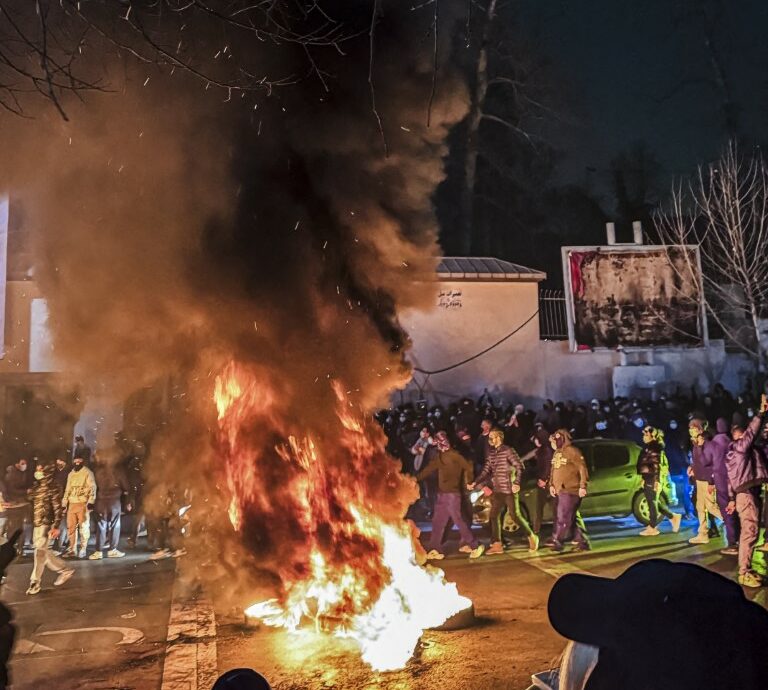


Despite a near-total internet shutdown, fresh protests erupted overnight in several major Iranian cities, including Tehran, Mashhad, Tabriz and Qom. The mobilisation—diffuse, without a central leadership or unified slogan—has unfolded under intensifying domestic repression and explicit threats from Washington, voiced by U.S. President Donald Trump.
According to Netblocks, an organisation that monitors global internet governance, access has been cut across the country for more than 36 hours, a tactic repeatedly used by Iranian authorities to isolate the population, disrupt coordination among protesters and block the flow of images and testimony.
Night-time protests, scarce information
Information remains fragmentary. Images show night-time gatherings, anti-government slogans and symbolic acts of protest. In Tehran’s Saadatabad neighbourhood, residents banged pots and pans from their windows, while drivers honked in solidarity.
Videos relayed by Persian-language broadcasters based abroad indicate similar scenes in Mashhad, Tabriz, Qom and Hamedan. Some footage features symbols from pre-1979 Iran, without pointing to any coherent political platform or unified agenda.
A movement distinct from 2022
Unlike the 2022 protests sparked by the death of Mahsa Amini, the current mobilisation does not explicitly claim the slogan “Women, Life, Freedom” and is not structured as a feminist uprising.
While women are visible among the protesters, the movement reflects broader social and political grievances, marked by the absence of a single message, organisation or recognised leadership.
Trump escalates rhetoric and raises the threat level
Against this already volatile backdrop, Donald Trump has repeatedly raised the tone. The U.S. president said Iran was facing “big problems” and warned that the United States would “hit very hard” if the authorities launched a deadly crackdown on protesters.
A day earlier, he praised what he described as the Iranian people’s “enthusiasm” for overthrowing the regime, while cautioning that it was premature for Reza Pahlavi—the son of the former shah—to assume a leadership role. Trump nevertheless suggested that “all options are on the table”, language that carries particular weight in U.S. diplomatic practice.
Closely watched in Iran and across the region, these statements have fuelled fears of escalation, at a time when the country is already weakened by sanctions and recent regional tensions.
U.S. support, NGO warnings
U.S. Secretary of State Marco Rubio said Washington supported the “courageous Iranian people”. Iranian authorities, for their part, accuse the United States and Israel of fomenting unrest—claims firmly rejected by the U.S. State Department.
Nobel Peace Prize laureate Shirin Ebadi warned of a possible “massacre under the cover of a total blackout”, citing credible reports of security forces raiding hospitals to arrest wounded protesters.
According to the Norway-based NGO Iran Human Rights, at least 51 people, including nine children, have been killed since the protests began in late December. Amnesty International says it is analysing evidence suggesting a recent intensification of repression.
An inflexible regime
Supreme Leader Ali Khamenei has said the country would not “back down”. The Revolutionary Guards have labelled the situation “unacceptable”, while the judiciary has vowed “maximum” punishment for protesters.
Foreign Minister Abbas Araghchi has downplayed the likelihood of foreign military intervention, while accusing Washington of seeking to deflect attention from Iran’s internal challenges.