
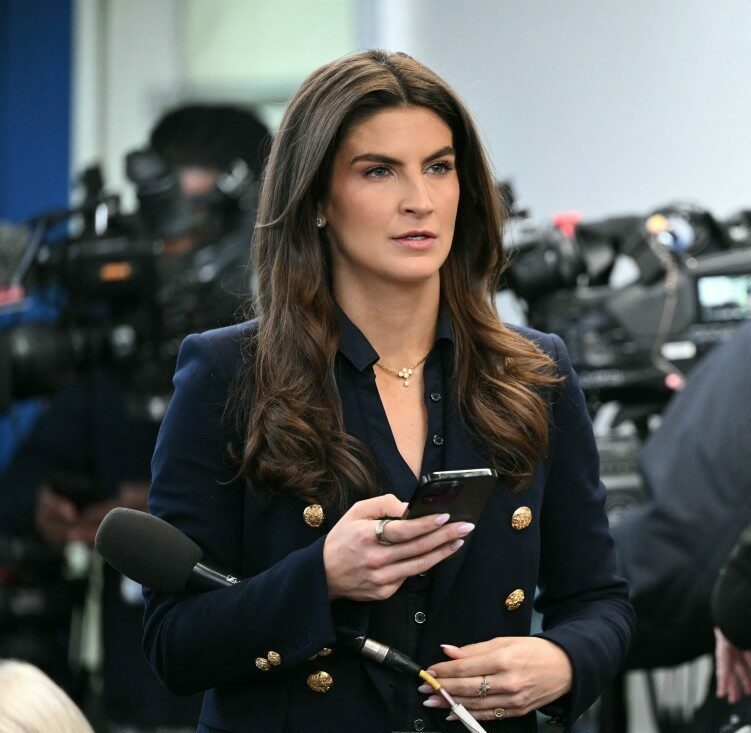


In the theater of political power, moments that appear minor often reveal the deepest structural truths. When Kaitlan Collins, chief White House correspondent for CNN, questioned U.S. President Donald Trump about the Epstein files and the demands of survivors seeking accountability, the exchange quickly shifted. Rather than answering the substance of the question, the president attacked the journalist personally, remarking that he had “never seen her smile.”
At first glance, the comment seemed trivial. Yet the episode captured something far more consequential: the enduring expectation that women in positions of authority must remain agreeable,and emotionally compliant, even when performing adversarial democratic functions such as questioning power.
Collins’ refusal to alter her tone and her continuation of questioning became, in effect, a quiet but unmistakable act of feminist resistance.
From Alabama reporter to the front line of power
Born in 1992 in Prattville, Alabama, Kaitlan Collins represents a generation of journalists who entered the profession during the era of permanent political spectacle. After graduating from the University of Alabama, she began covering politics in Washington, eventually joining CNN in 2017 as a White House correspondent. Her rise was rapid: within a few years she became one of the youngest chief White House correspondents in modern American television journalism, later hosting the primetime program The Source with Kaitlan Collins while continuing high-level political reporting.
Her career has repeatedly intersected with institutional pressure. In 2018, she was barred from a White House press event after asking persistent questions, prompting criticism from press-freedom organizations that saw the incident as retaliation against legitimate reporting. That early confrontation foreshadowed the dynamic that would later define many of her most visible moments: a journalist confronting political authority, and authority responding not only with disagreement but with attempts at personal delegitimization.
For women journalists, these attempts frequently take a specific form.
The gendered policing of demeanor
Political communication research has long documented that women in public roles are judged through a “double bind.” They must appear assertive enough to demonstrate competence yet sufficiently warm to remain socially acceptable. Male reporters are rarely evaluated according to whether they smile or appear pleasant while asking questions. Women, by contrast, are regularly subjected to commentary about their tone, facial expression, clothing that shift the evaluation from professional performance to personal presentation.
The remark directed at Collins, criticizing her for not smiling, fit precisely into this pattern. Rather than disputing the accuracy of her reporting or the relevance of her question about survivors of sexual exploitation, the criticism reframed the exchange as a matter of personality. In feminist media theory, such rhetorical moves are often described as gendered deflection: a strategy that redirects attention from accountability to appearance.
This tactic is not new. Across decades of political journalism, women correspondents who challenged authority, whether questioning war policy, corruption, or sexual-violence cases, have often faced attempts to delegitimize their authority through personal characterization. What has changed is the visibility of these moments. In the age of viral video, such exchanges circulate globally within minutes, transforming isolated interactions into symbolic events.
Journalism as feminist practice
Collins’ insistence on continuing her line of questioning carried particular significance because of the subject: survivors of Jeffrey Epstein’s trafficking network, whose long struggle for recognition and justice has exposed failures across legal, financial, and political institutions. By centering survivors’ concerns in a presidential briefing, the journalist was performing a democratic function that feminist theorists describe as representational amplification: bringing marginalized voices into spaces of decision-making power.
When a journalist asking about sexual-abuse survivors is criticized for not smiling, the moment illustrates more than interpersonal tension. It reveals how gender expectations can operate as informal mechanisms of power, subtly attempting to discipline the voices that challenge authority.
From this perspective, Collins’ neutrality—her refusal to perform friendliness under pressure—was not an emotional reaction but a professional stance. She maintained the posture expected of accountability journalism: factual framing, and persistence despite attempts at diversion.
A long history of women journalists confronting power
The Collins episode belongs to a longer historical trajectory. From the early twentieth-century investigative reporters who exposed labor exploitation, to war correspondents who challenged official narratives, women journalists have repeatedly had to fight not only for access but also for the legitimacy of their professional voice. Even after formal barriers fell, informal expectations—how a woman should speak or behave—continued to shape public reception.
Studies in political communication show that female reporters asking aggressive policy questions are more likely than male counterparts to be described as “combative,” “hostile,” or “emotional,” while men are framed as “tough” or “rigorous.” These linguistic asymmetries influence how audiences perceive credibility and authority, reinforcing structural biases even in formally equal professional settings.
Against this background, visible moments of resistance matter. They do not merely document individual courage; they slowly redefine the acceptable range of professional behavior. Each time a woman journalist refuses to soften her questioning to satisfy gender expectations, she contributes to shifting the norms that shape how the next generation will be evaluated.
The symbolism of a small gesture
The phrase “she doesn’t smile” might appear insignificant in the vast machinery of global politics. Yet symbolic politics often operates through such details. Public remarks about demeanor send signals—about who belongs in the room, about who must remain deferential, about whose authority is conditional.
Collins’ reaction—continuing her questioning without engaging the personal criticism—transformed the moment. By refusing the invitation to respond emotionally, she redirected the interaction back to the issue at stake: the survivors seeking answers. The gesture was understated, almost invisible, yet politically meaningful.
A generation redefining authority
Kaitlan Collins represents a broader transformation in political journalism. Younger correspondents, particularly women, operate in an environment where every briefing-room exchange can become a global clip within minutes. Visibility increases vulnerability to attacks, but it also creates new forms of symbolic power. When millions watch a journalist calmly persist despite personal criticism, the image reshapes expectations of what authority looks like.
Feminist scholars increasingly argue that such everyday acts—continuing to speak, continuing to question, refusing imposed emotional scripts—constitute a contemporary form of political participation. They do not resemble traditional activism; they occur within professional routines.
Ultimately, the importance of the episode does not lie in a single exchange between a president and a reporter. It lies in what the exchange reveals about the unfinished transformation of public space.
When Collins refused to modify her posture and continued asking about the Epstein survivors, she illustrated a principle that resonates far beyond journalism: equality is not only achieved through access to institutions but through the everyday exercise of authority within them.