
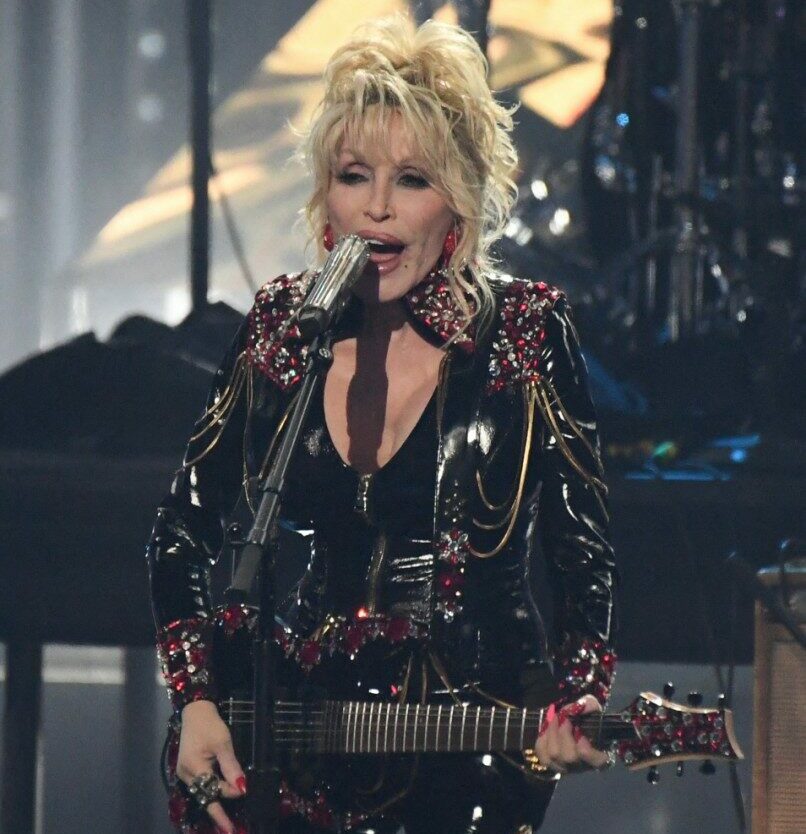


Dolly Parton is an American country singer, songwriter, actress, businesswoman and philanthropist born on January 19, 1946, in Sevier County, Tennessee. One of the most successful figures in country music, she is known worldwide for songs including “Jolene,” “I Will Always Love You” and “9 to 5.” Her career has also included film, television, the Dollywood theme park and Dolly Parton’s Imagination Library, her international children’s literacy program.
Who is Dolly Parton?
Dolly Rebecca Parton was born on January 19, 1946, in Sevier County, Tennessee, in the Great Smoky Mountains region. She was the fourth of 12 children born to Robert Lee Parton Sr. and Avie Lee Caroline Owens Parton.
Parton grew up in a low-income family in rural East Tennessee. Her father worked as a sharecropper and later in construction and other jobs, while her mother raised the family and passed on traditional songs and stories to her children. Religion and music were important parts of Parton’s childhood, and she began singing publicly at a young age, including in church.
Her background in the Smoky Mountains later became central to her songwriting, public identity, philanthropy and business activities.
Dolly Parton’s early career in Tennessee
Parton began performing as a child. By the age of 10, she was appearing on local radio and television in Knoxville, Tennessee. At 13, she recorded the single “Puppy Love” for Goldband Records and appeared at Nashville’s Grand Ole Opry.
After graduating from Sevier County High School in 1964, Parton moved to Nashville the following day to pursue songwriting and recording professionally.
She initially found success as a songwriter. Her compositions were recorded by other performers, and she signed with Monument Records in the 1960s. Her early label initially promoted her as a pop singer, but Parton wanted to work in country music.
Her 1967 recording “Dumb Blonde” became an early country success. The same year, she released her debut solo album, Hello, I’m Dolly.
Porter Wagoner and Dolly Parton’s breakthrough
A major turning point came in 1967, when country star Porter Wagoner invited Parton to join his syndicated television show, The Porter Wagoner Show.
The partnership gave Parton national exposure. Wagoner and Parton recorded numerous duets together while she simultaneously developed her solo career.
Their professional relationship lasted for several years, but Parton increasingly wanted to establish herself as an independent artist. She eventually left Wagoner’s show in 1974.
Parton wrote “I Will Always Love You” about their professional separation. Her original recording reached No. 1 on the U.S. country chart in 1974.
“Jolene”: the song that became a Dolly Parton signature
Dolly Parton released “Jolene” in 1973, with the album of the same name following in 1974. The song became one of the defining recordings of her career.
The lyrics describe a woman pleading with another woman not to take her partner. Parton has explained that the name came from a young fan she met, while the story was partly inspired by her feelings about an attractive bank employee who paid attention to her husband.
“Jolene” became a country standard and has been recorded by numerous artists. Decades after its original release, it remains one of Parton’s most streamed and internationally recognized songs.
Dolly Parton, Elvis Presley and “I Will Always Love You”
One of the best-known stories about Parton’s career concerns Elvis Presley and “I Will Always Love You.”
Parton has said that Presley wanted to record the song. However, his manager, Colonel Tom Parker, required a share of the publishing rights as part of the arrangement.
Parton declined because she did not want to give up a substantial part of the publishing ownership. Presley therefore did not record the song.
The decision became particularly significant years later.
In 1992, Whitney Houston recorded “I Will Always Love You” for the soundtrack to The Bodyguard. Houston’s version became an international No. 1 hit and one of the best-selling singles of all time.
Because Parton had retained her songwriting and publishing interests, she benefited financially from the recording’s enormous commercial success.
The episode is frequently cited as an example of Parton’s approach to music publishing, copyright ownership and financial independence.
Dolly Parton’s crossover from country to pop
During the second half of the 1970s, Parton expanded beyond the traditional country market.
Her 1977 album Here You Come Again was a major crossover success. Its title track reached No. 1 on the country chart and also became a significant pop hit.
This period established Parton not only as a country star but as a mainstream American entertainer with an audience extending well beyond Nashville.
She continued recording throughout the following decades, moving between traditional country, pop-influenced material, bluegrass and collaborations with artists from different generations.
“9 to 5,” Jane Fonda and Dolly Parton’s film career
Parton made her major film debut in 1980 in 9 to 5, starring alongside Jane Fonda and Lily Tomlin.
The comedy focuses on three women dealing with a sexist and abusive male boss. Parton wrote and performed the film’s title song, “9 to 5.”
The song addresses workplace inequality, low pay and the frustration of employees whose work benefits those above them. It became a major commercial success, reaching No. 1 on the Billboard Hot 100.
“9 to 5” earned Parton major music awards and an Academy Award nomination for Best Original Song.
Parton subsequently appeared in films including The Best Little Whorehouse in Texas (1982), Rhinestone (1984), Steel Magnolias (1989) and Straight Talk (1992).
Her acting career helped make her one of the relatively small number of country performers of her generation to achieve sustained mainstream recognition across music, film and television.
Dolly Parton as a songwriter and music rights owner
Songwriting has been central to Parton’s career from the beginning. She has written thousands of songs, both for herself and for other performers.
Her catalogue includes autobiographical songs, relationship songs, country narratives and songs addressing poverty, work and life in Appalachia.
Among her best-known compositions and recordings are “Jolene,” “I Will Always Love You,” “Coat of Many Colors,” “9 to 5,” “Here You Come Again” and “My Tennessee Mountain Home.”
Parton’s business decisions concerning publishing are also an important part of her career. By retaining control over valuable compositions, she combined the roles of performer, songwriter and rights holder at a time when female artists had considerably less power within the music business.
Dolly Parton, Linda Ronstadt and Emmylou Harris
In 1987, Dolly Parton joined Linda Ronstadt and Emmylou Harris for the album Trio.
The collaboration was a major critical and commercial success and won the Grammy Award for Best Country Performance by a Duo or Group with Vocal.
The three singers later released Trio II in 1999.
These recordings became an important part of Parton’s catalogue and demonstrated her continued connection to traditional country and American roots music despite her crossover success.
What is Dollywood?
Dollywood is a theme park in Pigeon Forge, Tennessee, near the Great Smoky Mountains and close to where Parton grew up.
Parton became involved with the existing Silver Dollar City Tennessee attraction in the 1980s, and the park reopened as Dollywood in 1986.
It subsequently developed into one of Tennessee’s major tourist attractions. The broader Dollywood business includes entertainment, hospitality and tourism operations in the region.
Dollywood is particularly significant to Parton’s biography because she built a major commercial enterprise close to her birthplace rather than separating her business identity from her Tennessee background.
The company has also become an important employer in the region.
Dolly Parton’s Imagination Library
Parton founded Dolly Parton’s Imagination Library in 1995 through the Dollywood Foundation.
The program began in Sevier County, Tennessee, with the goal of providing free books to young children regardless of their family’s income.
Eligible children receive an age-appropriate book by mail each month from birth until age five in participating communities.
The initiative subsequently expanded far beyond Tennessee and operates through local partners in multiple countries. It has distributed hundreds of millions of books since its creation.
Parton has linked her commitment to literacy to her father, who could not read or write. She has described the Imagination Library as one of the achievements of which she is most proud.
Dolly Parton’s philanthropy and COVID-19 research donation
Parton’s philanthropy extends beyond literacy.
In 2020, she donated $1 million to Vanderbilt University Medical Center to support coronavirus research. Her donation helped fund research connected to the development of the Moderna COVID-19 vaccine, although Parton herself did not develop or directly finance the vaccine as a whole.
She has also supported causes and relief efforts in Tennessee, including assistance following the 2016 Great Smoky Mountains wildfires.
Through the Dollywood Foundation and other initiatives, her philanthropy has remained closely connected to education and communities in her home state.
Who was Dolly Parton’s husband, Carl Dean?
Dolly Parton married Carl Thomas Dean on May 30, 1966, after meeting him in Nashville when she was 18.
Dean largely avoided public attention throughout Parton’s career and rarely appeared at entertainment industry events.
The couple did not have children. They remained married for nearly six decades, until Carl Dean died in March 2025 at the age of 82.
Parton frequently discussed their relationship in interviews while also protecting Dean’s preference for privacy.
Dolly Parton’s awards and honors
Over a career spanning decades, Parton has received major awards across country, pop, film and American culture.
She has won multiple Grammy Awards and Country Music Association Awards and has been inducted into the Country Music Hall of Fame.
In 2022, she was inducted into the Rock & Roll Hall of Fame. Parton initially said she did not feel she had earned the honor because she primarily considered herself a country artist, but she later accepted the induction.
She has also received the Kennedy Center Honors and numerous songwriting and lifetime achievement distinctions.
Her catalogue, songwriting career, recordings and crossover success have made her one of the most influential figures in American popular music.
Dolly Parton, women and the music industry
Dolly Parton has not consistently defined herself through the language of feminism, and descriptions of her as a feminist figure should distinguish between her own statements and interpretations of her career.
However, her professional history is particularly relevant to discussions about women’s economic independence in the music industry.
Parton entered country music when record labels, management companies, publishing businesses and television networks were overwhelmingly controlled by men. She nevertheless developed a career in which she was not simply an interpreter selected to perform other people’s material.
She wrote much of her own repertoire, protected important publishing rights, expanded into film and television, created businesses and used the wealth generated by her career to fund philanthropic projects.
Her experience also makes the history behind “9 to 5” particularly significant. The song brought questions of women’s work, pay, recognition and workplace sexism into mainstream American popular culture in 1980.
Dolly Parton’s career in numbers
Dolly Parton’s career spans more than six decades and includes dozens of studio albums, thousands of compositions and more than 100 million records sold worldwide according to widely reported industry estimates.
Her work extends across several distinct fields: country music, songwriting, film, television, music publishing, tourism, business and philanthropy.
The longevity of songs such as “Jolene,” “I Will Always Love You” and “9 to 5,” combined with the continuing scale of Dollywood and the Imagination Library, explains why Parton’s influence extends considerably beyond her record sales.
Why Dolly Parton remains an important figure in American culture ?
Dolly Parton’s biography is unusual because her public profile cannot be explained by a single hit song or even by her recording career alone.
She emerged from rural Tennessee, became a Nashville songwriter and country performer, crossed into mainstream pop culture, built a film career, retained valuable intellectual property, developed a major tourism business and created one of the world’s best-known private literacy initiatives.
For the history of women in entertainment, one element is particularly important: Dolly Parton combined creative authorship with ownership and commercial decision-making.
That combination made her not only one of country music’s most recognizable performers, but also an important case study in how a female artist built and maintained control over a long-term career in the American entertainment industry.