
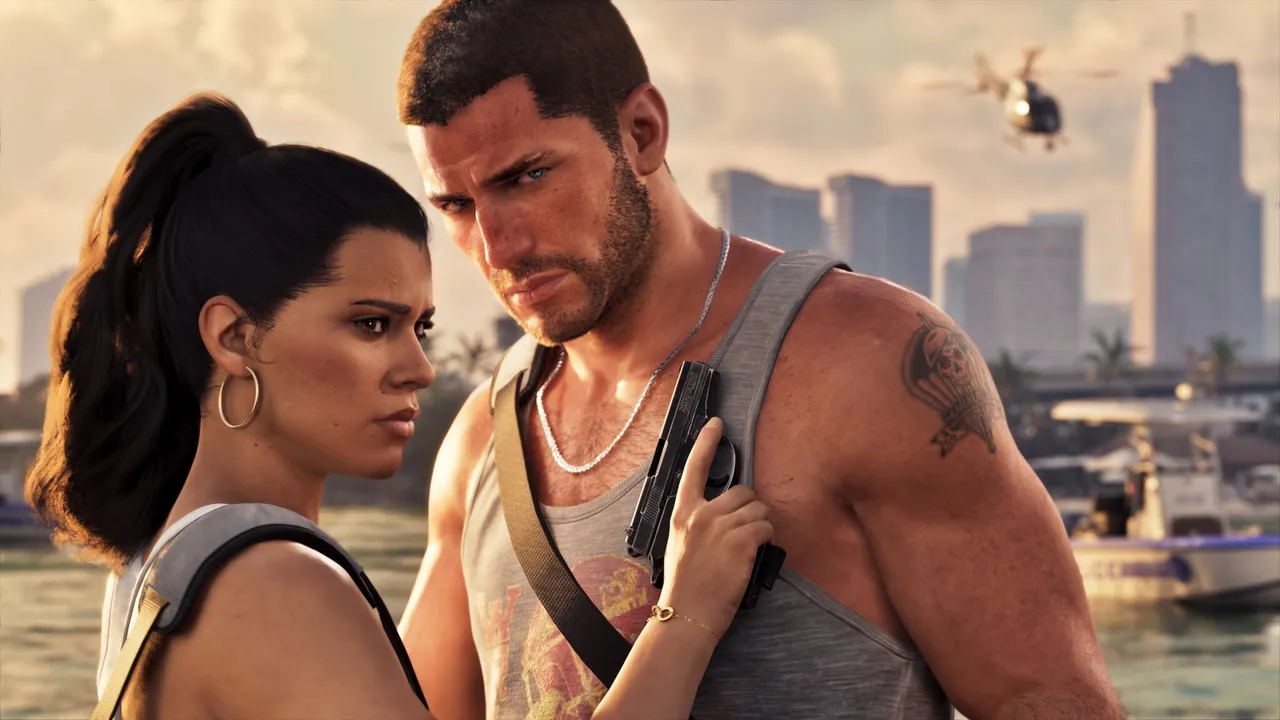


Grand Theft Auto VI has become a target for manosphere influencers accusing Rockstar Games of going “woke.” Their complaints center on Lucia Caminos, an independent female protagonist, and Jason Duval, a male character who shows affection for his partner. The controversy exposes a broader struggle over how women, masculinity, and relationships are represented in one of the world’s most influential entertainment industries.
In a video game built around robberies, criminal enterprises, and confrontations with law enforcement, could giving your girlfriend flowers really be the most controversial thing a man does?
That question lies at the heart of the backlash against Grand Theft Auto VI, better known as GTA 6. Some American manosphere influencers have accused Rockstar Games of abandoning the franchise’s masculine identity in favor of feminism and inclusion.
Since its debut in 1997, Grand Theft Auto has attracted criticism for its violence, sexualized portrayals of women, and depictions of prostitution. Now, some of the criticism runs in the opposite direction: a woman with agency and a man willing to care for her have become targets.
The dispute extends beyond a single game. It raises questions about who gets to shape popular culture, how outrage becomes a business, and why some online communities interpret women’s independence as a threat to men.
Why Is GTA 6 Being Called “Woke”?
Rockstar places a criminal couple at the center of GTA 6’s story, set in the fictional American state of Leonida, inspired by Florida.
Lucia Caminos and Jason Duval must navigate a dangerous environment together. Their relationship gives the franchise a different narrative structure, with a woman participating directly in the action rather than primarily serving as a supporting character or sexualized backdrop.
Lucia represents a significant shift for the mainline series. She has her own ambitions, makes decisions, and plays a central role in the story.
Even before release, Wired documented the anti-“woke” backlash surrounding Grand Theft Auto VI. Some critics objected to the prominence of women and minority characters, alongside what they perceived as changes in Rockstar’s creative direction.
The relationship between Lucia and Jason has also become a focus of criticism. In the French article supplied for this adaptation, examples include Jason giving Lucia flowers, planning dates, and participating in everyday activities with her.
Those details matter because of what the backlash suggests: for some critics, affection and cooperation diminish a male character’s credibility.
The underlying question is therefore less about whether Grand Theft Auto remains transgressive than about which forms of transgression its detractors consider acceptable.
A violent male protagonist fits familiar expectations. A powerful man who also takes his partner seriously challenges a different set of assumptions.
Lucia and Jason: Why Does a Caring Man Threaten the “Alpha Male” Ideal?
The backlash draws on a vocabulary that has become increasingly familiar across the manosphere: “alpha,” “beta,” “simp,” and “cuck.”
These labels turn relationships into status contests. A man’s standing is measured by how successfully he dominates others, avoids vulnerability, and resists being seen as influenced by a woman.
The French article cites criticism by streamer Asmongold and Fresh & Fit personality Myron Gaines, alongside Media Matters for America’s reporting on misogynistic reactions to GTA VI.
The terminology used in these communities reveals the hierarchy behind the criticism:
- “Alpha male” describes a supposedly dominant, powerful, sexually successful man.
- “Beta male” dismisses men who do not meet those expectations.
- “Simp” ridicules a man for giving a woman what others consider excessive attention or affection.
- “Cuck” is used more broadly to portray a man as submissive or insufficiently masculine.
Jason nevertheless possesses many traits traditionally associated with conventional masculinity. He is physically imposing and capable of operating in a violent criminal environment.
Yet, within this worldview, those qualities may be insufficient if he also respects his partner’s decisions.
This tension echoes sociologist Raewyn Connell’s concept of hegemonic masculinity: the social norms that legitimize men’s dominance over women while also establishing hierarchies among men.
Under those norms, an autonomous woman can be framed as a challenge to male authority. A caring man can be punished socially for failing to maintain that authority.
The controversy illustrates how these expectations extend into fictional worlds. A character’s emotional availability becomes a test of his masculinity, even when it has little bearing on his strength or competence.
For women, the message is equally restrictive: independence is acceptable only as long as it does not disturb the expected balance of power.
Why Does GTA 6 Matter to the Global Video Game Business?
Grand Theft Auto is far more than a niche cultural product. It is a global entertainment franchise with an audience that spans generations and markets.
Its reach makes debates about its characters commercially significant. The question of who appears in a game—and who feels represented by it—has implications for audience growth, brand identity, and the future of major franchises.
Take-Two Interactive, Rockstar’s parent company, reports its financial performance through corporate filings available from the U.S. Securities and Exchange Commission. Broader industry estimates are published by research firms such as Newzoo.
Those sources are essential for distinguishing reported sales from projections, consumer spending from company revenue, and copies sold from player counts.
The economics also differ from those of film. A game’s launch revenue cannot be compared directly with a movie’s box office without accounting for differences in price, distribution, development costs, and the timing of sales.
Still, the scale of the industry makes one point clear: representations of women and men in video games reach far beyond a small circle of enthusiasts.
For publishers, a broader range of protagonists can offer opportunities to renew established franchises and connect with different audiences.
That does not establish why Rockstar made particular creative decisions. Nor does the presence of a female lead automatically make a game feminist.
It does mean that claims about what “gamers want” deserve scrutiny. A vocal online community is not necessarily representative of the worldwide customer base.
Women play games, buy games, develop games, and contribute to gaming communities. Treating their presence as an intrusion obscures the reality of the market.
From Gamergate to Review Bombing: How Does Gaming Outrage Become a Business?
The GTA 6 dispute belongs to a longer history of conflict over gender and inclusion in gaming.
Gamergate, which emerged in 2014, was presented by some participants as a campaign about ethics in games journalism. It also became associated with harassment targeting women in the industry, including developer Zoë Quinn and feminist critic Anita Sarkeesian.
Today, similar arguments circulate across a much larger media ecosystem.
Streaming platforms, podcasts, YouTube, TikTok, and social networks allow commentators to turn a controversy involving a major release into a continuous stream of content.
One mechanism frequently discussed in these disputes is review bombing: a surge of negative user ratings intended, in some cases, to damage a product’s public reputation.
However, low user scores alone do not establish a coordinated ideological campaign. Players may criticize technical performance, pacing, pricing, platform availability, or other aspects of a game.
It is therefore essential to distinguish documented misogynistic comments from the full range of audience criticism.
The economic incentives behind outrage also deserve attention.
Polarizing content can generate views, subscriptions, advertising income, and opportunities to sell courses or personal development programs. A controversy involving a franchise as recognizable as Grand Theft Auto offers access to an enormous potential audience.
Ideology and commercial incentives can reinforce each other. A creator may hold antifeminist views while also benefiting financially from repeatedly presenting popular culture as a battlefield.
The Women’s Voices has explored these broader mechanisms in its reporting on the expansion of masculinist networks and their influence across society. Although that article focuses on France, it examines channels that also shape international online discourse: fitness, dating advice, financial success, personal development, and entertainment.
The revenue generated specifically by GTA-related outrage remains difficult to measure. The incentive to capture attention, however, is central to understanding how these controversies spread.
What Does the GTA 6 Backlash Reveal About Misogyny Online?
The dispute reflects a recurring narrative within the manosphere: gains in women’s autonomy are presented as losses for men.
France’s High Council for Gender Equality, known as the HCE, examines this dynamic in its 2026 report on sexism and the masculinist threat.
The report describes an ideology that treats progress toward gender equality as an attack on men’s position in society.
Its findings concern France and should not be treated as measurements of American gamers or the U.S. population. The framework nevertheless offers a useful way to examine the arguments circulating around GTA 6.
In those arguments, a woman’s independence becomes evidence that men have lost control. A man’s affection becomes evidence that he has surrendered it.
That view limits women’s freedom, but it also restricts men. It discourages emotional expression, cooperation, and relationships based on mutual respect.
Showing consideration for a partner becomes a liability rather than an ordinary part of adult life.
None of this means GTA 6 should be treated as a feminist manifesto. A female protagonist does not erase every sexualized representation, and a caring male character does not resolve the industry’s problems with sexism.
Nor do the reactions of a few influencers represent every player.
The controversy matters because video games help circulate ideas about power, identity, and relationships to audiences around the world. They are cultural spaces in which social expectations are reproduced, challenged, and debated.
The central paradox is striking: in a franchise famous for criminality and violence, some critics appear more disturbed by a man caring for his girlfriend than by the crimes he commits.
That reaction says less about whether a fictional man is strong enough than about how narrowly some communities define strength.