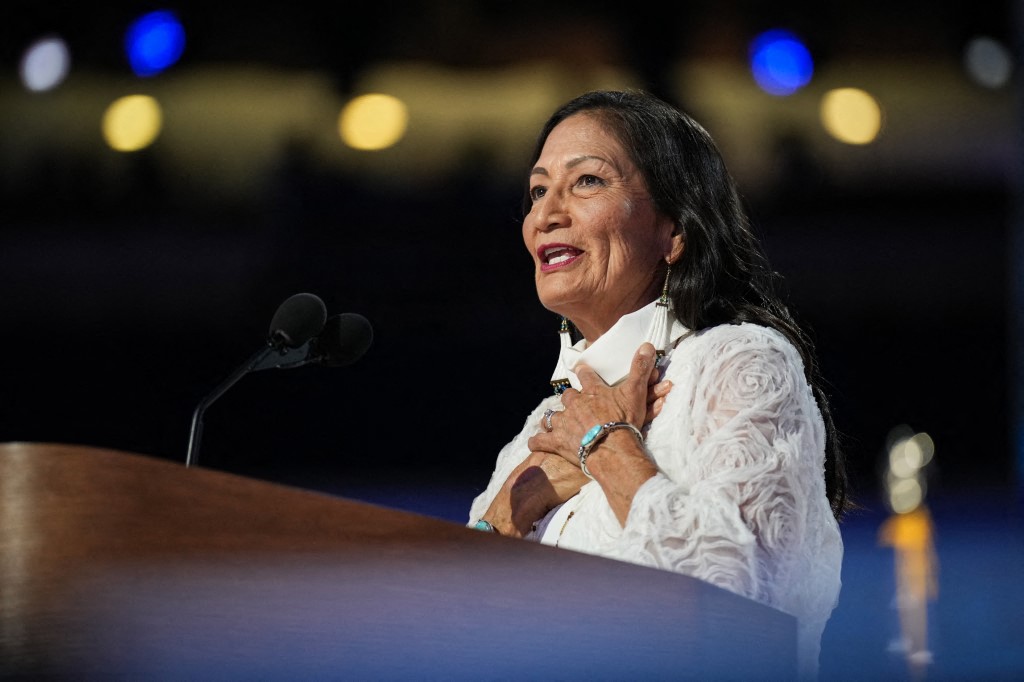


Deb Haaland has broken another glass ceiling in American politics. After becoming one of the first Native American women elected to Congress in 2018 and the first Native American Cabinet secretary in 2021, the Democrat has made history for a third time. On November 3, 2026, she defeated Republican Gregg Hull to become the first Native American woman elected governor of a U.S. state. Her victory in New Mexico marks another milestone in a remarkable political journey, from single motherhood and financial hardship to some of the highest positions in American government.
Deb Haaland has spent much of her political career entering institutions where Native American women had never held positions of comparable authority. Her election as governor of New Mexico represents the latest milestone in a journey that has taken her from grassroots organizing to Congress, the Biden administration, and now the leadership of a state with deep historical ties to Indigenous communities.
The 65-year-old Democrat, a member of the Laguna Pueblo, defeated Republican Gregg Hull, the former mayor of Rio Rancho, in the November 3 midterm elections. According to preliminary results reported by local public radio station KUNM, she received approximately 57% of the vote.
Haaland will succeed Democratic Governor Michelle Lujan Grisham, who is completing her second consecutive term. Her victory comes during an election cycle marked by several historic breakthroughs for women, but it carries particular significance for Native American political representation.
Three Glass Ceilings Broken: Congress, the Cabinet, and the Governor’s Office
Deb Haaland’s election is the third major political first of her career.
In 2018, she and Sharice Davids of Kansas became the first two Native American women elected to the U.S. House of Representatives. Haaland represented New Mexico’s 1st Congressional District, which includes Albuquerque, bringing issues affecting Indigenous communities, public lands, and working families into national legislative debates.
Three years later, President Joe Biden nominated her to serve as secretary of the interior. Confirmed by the Senate in March 2021, she became the first Native American person in U.S. history to hold a Cabinet secretary position.
As head of the Department of the Interior, Haaland oversaw an agency with nearly 70,000 employees and responsibilities ranging from national parks and federal lands to natural resources and the federal government’s relationships with tribal nations.
Her appointment was especially significant because the department had historically administered policies that profoundly affected Indigenous peoples, including the removal of Native Americans from ancestral lands and the federal boarding school system.
Now, her election as governor adds a third milestone. She will become the first Native American woman to lead a U.S. state, assuming executive responsibility for public education, healthcare, economic development, and state administration.
The progression from Congress to the federal Cabinet and then to a governor’s office is unusual in American politics. For Haaland, it also reflects the gradual expansion of Indigenous representation within institutions that historically excluded Native Americans from positions of power.
From Single Mother Facing Poverty to National Political Leadership
Haaland’s political journey began far from the privileged networks often associated with American elected office.
Born in 1960, she grew up in a military family, attending 13 public schools before graduating from high school in Albuquerque. Her father served in the U.S. Marine Corps, while her mother, a member of Laguna Pueblo, served in the Navy and later worked for the Bureau of Indian Affairs.
As a single mother, Haaland struggled financially while raising her child. She relied on food assistance at times, lived paycheck to paycheck, and took on additional work to support her family.
She returned to higher education as an adult, earning a bachelor’s degree in English from the University of New Mexico at age 34 and later completing a law degree at the same university.
To make ends meet, she worked in catering and operated a small business producing and selling salsa. She also served as a tribal administrator at San Felipe Pueblo and became the first woman elected to the board of the Laguna Development Corporation.
These experiences shaped her understanding of economic insecurity, particularly the difficulties facing parents who must balance employment, childcare, education, and healthcare expenses.
Her political involvement expanded through voter registration efforts and community organizing. She worked on Native American voter outreach during Barack Obama’s 2012 presidential campaign and later became chair of the New Mexico Democratic Party.
Her career demonstrates how political leadership can emerge through local organizing, professional experience, and community institutions rather than through an early career in elected office.
Native American Women and the Long Struggle for Political Representation
Haaland’s election takes place against a historical background in which Native Americans faced extensive legal and institutional barriers to political participation.
Although Congress granted U.S. citizenship to all Native Americans born in the country in 1924, several states continued to restrict their voting rights for decades.
In New Mexico, a landmark 1948 court ruling helped secure voting rights for Native American residents after Miguel Trujillo, a member of Isleta Pueblo and a World War II veteran, challenged the state’s restrictions.
More recently, debates over polling locations, identification requirements, access to transportation, and the use of nontraditional residential addresses have continued to affect voting access in some tribal communities.
New Mexico has 23 federally recognized tribes, nations, and pueblos. Native Americans represent approximately 12% of the state’s population, making Indigenous political participation particularly important to its public institutions.
Haaland’s election does not imply that Native American communities share a single political outlook. Their priorities differ across tribal nations, geographic regions, and generations, while tribal sovereignty creates distinct legal relationships with federal and state governments.
Nevertheless, her victory represents a significant development in the representation of Indigenous women, who have historically been largely absent from the highest levels of American executive government.
It also draws attention to issues affecting Native American women, including violence, economic inequality, healthcare access, and the protection of tribal rights.
Deb Haaland’s Record on Missing Indigenous Women and Boarding Schools
During her time in Congress and the Biden administration, Haaland focused on several issues with particular significance for Native American communities.
One was the crisis of missing and murdered Indigenous women and girls, which has prompted growing demands for improved investigations, more reliable data, and stronger cooperation between federal, state, and tribal authorities.
The complex division of law enforcement responsibilities across tribal, federal, and state jurisdictions has often made investigations more difficult. Haaland supported efforts to improve coordination and draw national attention to cases that had historically received limited public scrutiny.
As interior secretary, she also launched the Federal Indian Boarding School Initiative in 2021, directing the federal government to investigate its historical role in the forced assimilation of Indigenous children.
For generations, Native American children were removed from their families and placed in institutions where many were prohibited from speaking their languages or practicing their cultural traditions.
The department’s final investigative report, released in July 2024, documented the extensive federal boarding school system, including student deaths, burial sites, and the role of religious organizations.
The initiative represented an effort to establish a fuller historical record and acknowledge the consequences of federal policies for Indigenous families and communities.
These issues will remain relevant as Haaland takes office in New Mexico, where cooperation with tribal governments is essential in areas such as public safety, education, healthcare, and natural resource management.
Healthcare, Education, and Affordability: What Comes Next for New Mexico?
While Haaland’s election carries historic symbolism, her administration will be evaluated on its response to the practical concerns of New Mexico residents.
During her campaign, she emphasized the cost of living, access to healthcare, public education, child welfare, and economic opportunities for working families.
She proposed creating a public health insurance option to expand coverage and address affordability, particularly in rural communities where access to healthcare professionals can be limited.
Her education agenda includes improving early literacy, strengthening support for teachers, and expanding opportunities for vocational training and higher education.
Child welfare is another priority. New Mexico’s Children, Youth and Families Department has faced persistent criticism over its ability to protect vulnerable children and respond effectively to reports of abuse and neglect. Haaland has called for reforms to improve oversight and services.
She has also proposed a temporary pause on major new data center projects while the state evaluates their potential impact on electricity demand, water resources, and local infrastructure.
Her environmental background may shape the way her administration approaches these questions, although New Mexico’s economy also depends significantly on oil and gas production, creating competing priorities involving public revenue, employment, and climate policy.
The state’s Democratic-controlled legislature could provide opportunities for cooperation, but individual proposals will still require budgetary decisions, legislative approval, and negotiations with affected communities.
A Historic Election, and the Challenge of Turning Representation Into Policy
Deb Haaland’s victory is part of a broader shift in women’s political representation during the 2026 midterm elections. In Georgia, Keisha Lance Bottoms has become the first Black woman elected governor of a U.S. state, while Texas has elected its first Latina governor, Gina Hinojosa.
These milestones reflect different political trajectories and communities, but they also highlight how recently some of America’s highest offices have become accessible to women from historically underrepresented backgrounds.
For Haaland, the symbolism is especially striking. A woman who once relied on food assistance to raise her child has now been elected to lead a state whose history is deeply intertwined with the experiences of Indigenous peoples.
Yet her election also raises a larger question about the relationship between representation and political change. Historic firsts can broaden the range of perspectives within government, but meaningful improvements in people’s lives depend on public policy, institutional cooperation, and the effectiveness of elected officials.
When Haaland takes office in January 2027, she will face the same expectations as any governor: delivering public services, managing state finances, and responding to the concerns of residents with different political priorities.
Deb Haaland has already broken three major glass ceilings in American politics. Her next challenge will be turning that historic journey into measurable results for the people of New Mexico.