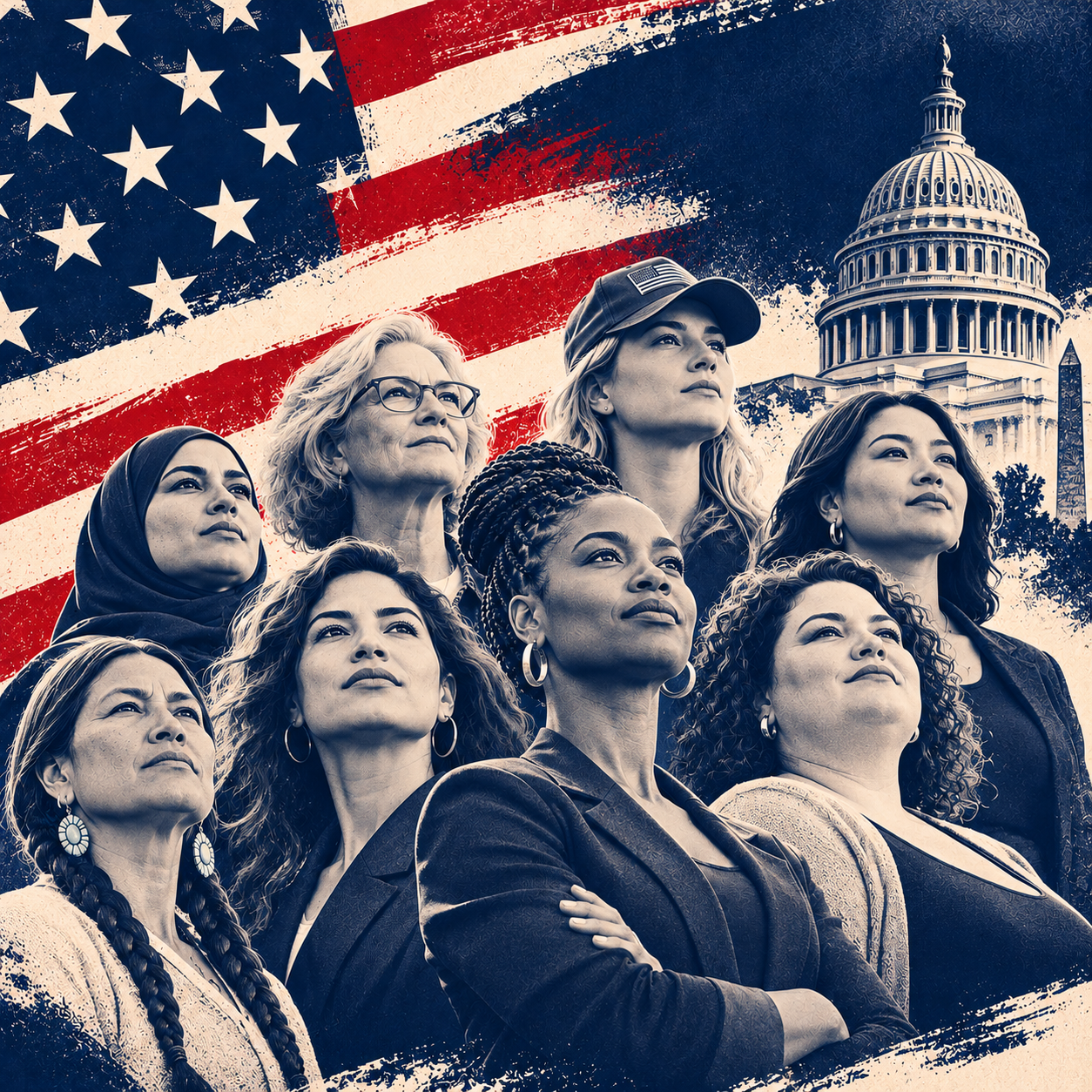


Nearly 9 million more women than men voted in the 2024 presidential election. Yet women hold just 28% of seats in the U.S. Congress. As Americans head to the polls on November 3, 2026, a record number of female gubernatorial nominees and several potentially historic candidacies highlight a persistent contradiction in American democracy: women have enormous electoral influence, but remain significantly underrepresented in political leadership.
Women have become one of the most powerful forces in American elections. They consistently turn out to vote at higher rates than men, play a decisive role in competitive states and increasingly shape national political debates.
Yet their influence at the ballot box has not translated into equal representation in Washington.
On the eve of the 2026 midterm elections, women occupy fewer than three in ten seats in Congress, despite accounting for approximately 51% of the U.S. population.
The contrast raises a fundamental question: why does a country where women vote more than men continue to elect overwhelmingly male political institutions?
Nearly 9 Million More Women Than Men Voted in 2024
The numbers reveal the scale of women’s electoral influence.
According to U.S. Census Bureau data analyzed by the League of Women Voters in March 2026, 91.3 million women voted in the 2024 presidential election, compared with 82.6 million men.
That represents an extraordinary difference of 8.7 million voters.
The pattern was already evident during the previous midterm elections. In 2022, approximately 64 million women cast ballots, compared with roughly 58 million men.
Women have consistently registered higher turnout rates than men in every presidential election since 1980.
Their participation is therefore not a temporary political phenomenon linked to a particular candidate or election. It reflects a longstanding structural characteristic of American democracy.
Research from the Center for American Women and Politics (CAWP) at Rutgers University also highlights differences across demographic groups. Black women have historically demonstrated particularly strong electoral engagement, while younger women have increasingly become an important constituency in national elections.
However, higher participation does not mean that women vote as a unified political bloc.
Their preferences differ substantially according to race, education, religion, age and geography. These divisions help explain why women’s numerical electoral strength does not automatically produce greater political representation.
The 2026 midterms will once again test the political influence of an electorate that is both highly engaged and deeply divided.
Only 152 Women Serve in the 535-Member U.S. Congress
The gap between women’s electoral participation and their political representation is particularly visible on Capitol Hill.
As Americans prepare to elect a new Congress, 152 women currently serve in the House of Representatives and Senate combined, representing approximately 28.4% of the 535 congressional seats.
The imbalance exists in both chambers.
In the House of Representatives, women hold 125 of the 435 seats, or approximately 28.7%.
In the Senate, just 27 of the 100 members are women.
These figures represent substantial progress compared with previous generations. For much of American history, women were almost entirely absent from Congress.
The 1992 elections, widely remembered as the Year of the Woman, marked a turning point after several women won high-profile Senate races.
Since then, female representation has increased, although progress has been uneven and remains far from parity.
In 2026, all 435 House seats are up for election, along with 35 Senate contests, including special elections.
But the election does not necessarily guarantee an increase in female representation.
According to Rutgers University’s latest pre-election analysis, 17 incumbent congresswomen are leaving the House because of retirement, primary defeats or campaigns for other offices.
At least 17 non-incumbent women must therefore win seats simply to maintain the current level of female representation, assuming all other incumbent women retain their seats.
The Senate faces similar challenges. Some female senators are retiring, while others are seeking reelection in competitive states.
The result could produce historic individual victories without significantly changing the overall gender balance of Congress.
This distinction matters: electing more women to individual offices is not the same as achieving lasting gender parity across political institutions.
White, Black and Latina Women: America’s Female Electorate Is Deeply Divided
The political preferences of American women are far from uniform.
During the 2024 presidential election, women overall favored Democrat Kamala Harris over Republican Donald Trump.
According to Edison Research exit polls, Harris received approximately 53% of the female vote, compared with 45% for Trump.
But the national average conceals substantial racial, educational and religious differences.
Among white women, Trump won approximately 53% of the vote, while Harris received 46%.
Black women overwhelmingly supported Harris, giving her approximately 92% of their votes.
Latina voters also favored the Democratic candidate, although by a narrower margin, with approximately 60% supporting Harris and 38% voting for Trump.
Differences between women and men within the same racial and ethnic groups were equally revealing.
Black men were more likely than Black women to support Trump, while Latino men favored the Republican candidate more strongly than Latina women.
Education created another significant divide.
Among white women with college degrees, approximately 58% supported Harris. By contrast, nearly two-thirds of white women without college degrees voted for Trump.
Religion was also a major factor. Around 80% of white evangelical women supported the Republican president.
These differences challenge the assumption that women necessarily vote according to a shared understanding of gender equality or reproductive rights.
For many voters, inflation, immigration, public safety, religious identity and economic opportunity carry greater political weight.
The 2026 midterms will provide another indication of whether these divisions are becoming more pronounced, particularly in states where both parties are competing for suburban women and working-class voters.
Understanding the female electorate therefore requires moving beyond the idea of a single gender gap.
There is no unified women’s vote in America. There are multiple female electorates, shaped by different experiences, priorities and political identities.
Georgia, New Mexico and Alaska: Women Could Make Political History
Despite their continued underrepresentation, several women could achieve historic breakthroughs in the 2026 midterms.
In Georgia, Democrat Keisha Lance Bottoms, the former mayor of Atlanta, is running against Republican businessman Rick Jackson, who has received Donald Trump’s endorsement.
If elected, Bottoms would become the first Black woman to serve as governor of any U.S. state.
Her victory would also make her Georgia’s first woman governor and its first Black governor.
The race is particularly significant in a state that has been governed by Republicans since 2003 but has emerged as one of the country’s most competitive electoral battlegrounds.
In New Mexico, Deb Haaland, a member of the Laguna Pueblo tribe and former U.S. secretary of the interior, could become the first Native American woman to serve as governor of a U.S. state.
Her candidacy represents another potential milestone for communities that have historically been excluded from the highest levels of political power.
In Minnesota, Democrat Amy Klobuchar and Republican Lisa Demuth are competing for the governorship. Regardless of the result, the state will elect its first woman governor.
In Ohio, Democrat Amy Acton, a former state health director who became nationally known during the COVID-19 pandemic, is running against Republican entrepreneur Vivek Ramaswamy.
Acton could become the first woman elected governor of Ohio. Her campaign has also attracted national attention following deeply personal attacks involving allegations about her childhood.
The Senate could witness historic breakthroughs as well.
In Alaska, Democrat Mary Peltola, a member of the Yup’ik Indigenous community and former U.S. representative, is challenging Republican Senator Dan Sullivan.
Peltola could become the first Alaska Native person elected to the U.S. Senate.
In Minnesota, Democratic candidate Peggy Flanagan, a member of the White Earth Nation, is also seeking a Senate seat.
A victory by either candidate would represent a historic milestone for Native American women’s representation in the upper chamber of Congress.
These campaigns demonstrate that political representation is not simply a question of gender. Race, ethnicity, geography and historical exclusion continue to shape access to political leadership.
According to Pew Research Center, 17 U.S. states have never had a woman governor, while 15 have never elected a woman to the Senate.
More Women Are Running, but Political Power Remains Unequal
The 2026 elections have produced important gains in female candidacies.
According to the Center for American Women and Politics, 271 women secured major-party nominations for the House of Representatives, including 198 Democrats and 73 Republicans.
Women account for approximately 31.8% of all major-party House nominees.
The partisan difference is striking.
Women represent 45.5% of Democratic House nominees but only 17.6% of Republican nominees.
The gap is also visible in gubernatorial elections.
A record 26 women are running for governor as major-party nominees, including 19 Democrats and seven Republicans.
Women make up a majority of Democratic gubernatorial nominees but fewer than one in five Republican nominees.
Meanwhile, 19 women are major-party nominees for the U.S. Senate, fewer than the record of 23 established in 2018.
These figures illustrate a broader structural challenge.
Female candidates remain unevenly distributed across parties and constituencies. Their electoral prospects depend not only on their qualifications or popularity but also on access to campaign funding, party support and competitive districts.
Women must also navigate political environments in which personal attacks can become particularly aggressive.
The Ohio gubernatorial campaign provides a striking example. Amy Acton was targeted by a Republican advertisement featuring her estranged mother, who disputed the candidate’s account of childhood trauma.
The controversy prompted a national debate about the use of deeply personal allegations in political advertising.
Such attacks illustrate how electoral competition can extend far beyond disagreements over policy.
Campaign financing represents another obstacle.
Although women participate actively in political fundraising, large financial contributions remain disproportionately concentrated among men, while wealthy candidates can deploy substantial personal fortunes.
The result is a political system in which women are increasingly visible as voters, activists, donors and candidates, but remain significantly underrepresented among elected decision-makers.
The 2026 Midterms: Can Women’s Electoral Power Become Political Power?
The November 3 elections take place at a particularly consequential moment for women’s rights in the United States.
Since the Supreme Court overturned Roe v. Wade in 2022, state governments have gained far greater authority over abortion restrictions.
Governors, state legislators and state courts now play central roles in determining access to reproductive healthcare.
Healthcare coverage, childcare costs, housing affordability and education are also major issues across the country.
Yet women’s political interests extend far beyond policies traditionally associated with gender.
Women are voters, workers, business owners, taxpayers and community leaders whose decisions influence every dimension of American public life, from national security to economic policy.
Their underrepresentation in Congress therefore raises a broader question about democratic legitimacy and political inclusion.
More than a century after the ratification of the 19th Amendment, which prohibited denying voting rights on the basis of sex, women continue to face obstacles to equal political representation.
The 2026 midterms may deliver several historic victories. America could elect its first Black woman governor, its first Native American woman governor and potentially its first Native American woman senator.
But individual breakthroughs do not necessarily translate into structural change.
The ultimate measure of progress will be whether women gain a larger and more durable share of political power.
American women have outvoted men for more than four decades. Yet they still occupy fewer than three in ten seats in Congress. As millions of Americans head to the polls, that contradiction remains one of the most revealing measures of the distance between electoral participation and political equality.