
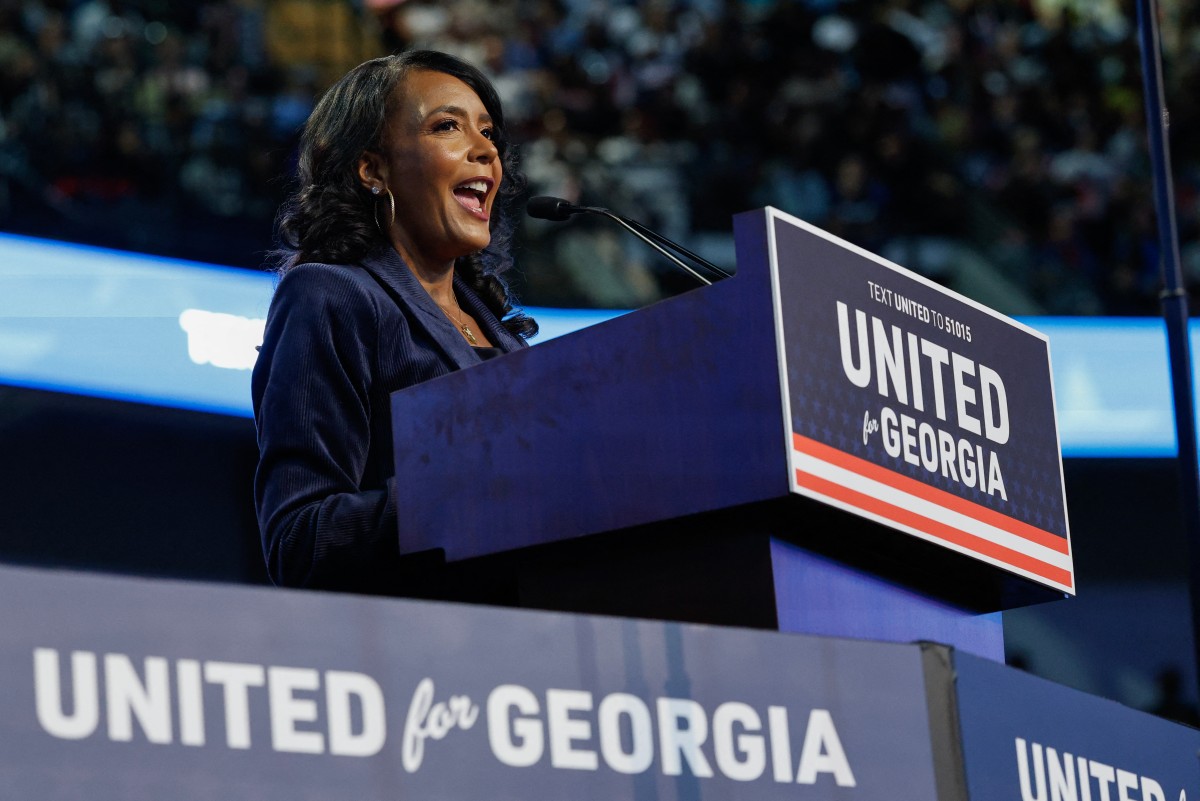


As Georgia prepares to vote on November 3, 2026, Democrat Keisha Lance Bottoms is seeking to make American political history. The former Atlanta mayor could become the first Black woman ever elected governor of a U.S. state. Facing Republican billionaire Rick Jackson in one of the country’s most competitive gubernatorial races, Bottoms is campaigning on abortion rights, healthcare access and the cost of living. With women accounting for 56% of Georgia’s early voters, the outcome could mark a turning point for political representation in America.
Keisha Lance Bottoms: From Atlanta Mayor to a Historic Run for Governor
At 56, Keisha Lance Bottoms is no newcomer to American politics. A lawyer and former Atlanta City Council member, she served as mayor of Georgia’s largest city from 2018 to 2022, navigating the COVID-19 pandemic, racial justice protests and growing concerns over violent crime.
Her leadership attracted national attention in 2020, when demonstrations erupted across the United States following the murder of George Floyd. In Atlanta, tensions intensified after the fatal police shooting of Rayshard Brooks, placing Bottoms at the center of a national debate over policing, racial inequality and public safety.
Her record remains contested. Supporters point to her experience managing a major American city during unprecedented crises, while critics question her administration’s handling of crime and public safety.
After deciding not to seek reelection as mayor in 2021, Bottoms moved into national politics. She joined President Joe Biden’s administration as director of the White House Office of Public Engagement, a position that strengthened her relationships with national Democratic leaders. Now, she is attempting to translate that experience into a statewide victory in Georgia, where Republicans have controlled the governor’s office since 2003.
Bottoms secured the Democratic nomination in May 2026, winning approximately 56% of the primary vote and avoiding a runoff. Her victory demonstrated her standing within the party, but the general election presents a substantially different challenge.
Georgia remains deeply divided politically, and winning statewide requires building a coalition that extends beyond Atlanta and its Democratic strongholds.
Why Georgia Could Make History for Black Women in American Politics ?
Despite nearly 250 years of American independence, no Black woman has ever served as governor of a U.S. state. A victory for Bottoms would therefore represent several historic firsts: she would become Georgia’s first woman governor, its first Black governor and the first Black woman governor anywhere in the United States. The significance extends beyond a single election.
Black women have long played a central role in American political organizing, particularly within the Democratic Party. Their participation has helped shape presidential campaigns, congressional elections and voting rights movements, yet their representation in the highest executive offices remains limited.
Georgia offers a particularly powerful historical backdrop. Atlanta was a major center of the civil rights movement and the home of Martin Luther King Jr. The city has produced generations of influential Black political leaders, but the state has never elected a Black governor.
Bottoms is also following a path shaped by Stacey Abrams, the Democratic candidate who challenged Republican Brian Kemp in the 2018 and 2022 gubernatorial elections. Although Abrams lost both races, her campaigns helped bring national attention to Georgia’s changing electorate, voter registration efforts and the political influence of Black women.
Bottoms now has an opportunity to achieve a breakthrough that has eluded previous generations of candidates.
Her candidacy also follows the historic vice presidency of Kamala Harris, who became the first woman, first Black American and first person of South Asian descent to hold that office in 2021.
Yet Harris’s achievement did not eliminate the barriers facing women of color in American politics. The governorship remains one of the most significant positions from which Black women have been excluded.
Rick Jackson vs. Keisha Lance Bottoms: Two Competing Visions for Georgia
Bottoms faces Rick Jackson, a billionaire healthcare entrepreneur and founder of Jackson Healthcare, who has never held elected office.
Jackson, 71, has built his campaign around his business experience, conservative economic policies and promises to lower taxes. His personal story, which includes growing up in foster care before building a successful healthcare company, has become an important part of his political identity.
He has the backing of President Donald Trump and outgoing Republican Governor Brian Kemp, who is barred from seeking a third consecutive term.
Jackson’s campaign emphasizes tax cuts, economic growth and continuity with the state’s Republican leadership. He has also criticized Bottoms’s record as Atlanta mayor, particularly on public safety.
The contrast between the candidates became especially visible during the campaign’s debate controversy.
On October 12, Bottoms appeared at an Atlanta Press Club debate beside an empty podium after Jackson declined to participate. She used the event to outline proposals on Medicaid expansion, affordable housing and education.
The two candidates subsequently faced each other in a televised debate on October 28.
Money has also played a major role in the contest. Jackson has deployed substantial personal resources, giving him an enormous financial advantage.
Nevertheless, polling has shown an exceptionally competitive race.
An Atlanta Journal-Constitution/University of Georgia poll published on October 20 placed Jackson at 46% and Bottoms at 45%, with 8% undecided. The one-point difference was well within the survey’s margin of error.
By October 31, the Decision Desk HQ polling average showed both candidates at approximately 47.8%, underscoring how little separated them ahead of Election Day.
The outcome remains uncertain, despite the Republican candidate’s considerable spending advantage.
Abortion Rights and Medicaid: What Is at Stake for Georgia Women?
Beyond its historical significance, Georgia’s gubernatorial election could have important consequences for women’s healthcare and reproductive rights.
Following the U.S. Supreme Court’s 2022 decision overturning Roe v. Wade, Georgia began enforcing a restrictive abortion law that generally prohibits the procedure once embryonic cardiac activity can be detected, typically around six weeks of pregnancy.
At that stage, some women may not yet realize they are pregnant.
The law includes limited exceptions, but its implementation has raised concerns among reproductive rights advocates and healthcare professionals about medical decision-making, access to emergency treatment and maternal health.
Bottoms supports abortion rights and wants to reverse Georgia’s restrictive approach. Jackson supports the state’s existing abortion law.
The difference illustrates the growing power of governors over reproductive healthcare following the Supreme Court’s decision to return abortion regulation largely to individual states.
However, even if Bottoms wins, she would not be able to repeal the abortion restrictions unilaterally. Legislative approval would be required, making the composition of Georgia’s General Assembly another important factor.
Healthcare coverage represents a second major dividing line.
Georgia is among the states that have not adopted full Medicaid expansion under the Affordable Care Act.
Bottoms supports expanding Medicaid eligibility to adults earning up to 138% of the federal poverty level. She argues that broader coverage would help low-income residents, improve access to medical treatment and support financially vulnerable rural hospitals.
Jackson has proposed a more limited expansion model that would maintain work-related requirements for eligible adults.
The debate carries particular significance for women, who often face overlapping challenges involving healthcare costs, pregnancy-related care, childcare responsibilities and economic insecurity.
Both candidates also emphasize affordability, although their proposals differ.
Bottoms has outlined measures involving housing, education and tax relief, while Jackson favors substantial income tax reductions and a business-oriented approach to economic growth.
These issues are central to a race in which voters are being asked to choose not only a new governor but also competing approaches to the role of state government.
Women Make Up 56% of Georgia’s Early Voters
One of the most striking developments ahead of Election Day has been the strength of female participation.
According to figures reported by Atlanta public radio station WABE on October 30, women accounted for approximately 56% of early voters in Georgia, compared with 44% for men.
That represents a 12-percentage-point participation gap.
The figures do not establish how women voted, and female voters should not be treated as a politically uniform group. Political preferences vary significantly according to race, age, education, income, religion and geography.
Nevertheless, the numbers highlight women’s importance in determining the outcome.
Georgia has also experienced record-breaking early voting for a midterm election, with more than 2.5 million ballots cast before the early voting period ended.
The state has become one of the clearest examples of America’s changing electoral landscape.
Joe Biden narrowly carried Georgia in the 2020 presidential election, winning by fewer than 12,000 votes. Donald Trump reclaimed the state in 2024.
This political volatility reflects the growing importance of Atlanta’s suburbs, demographic changes, rural Republican support and the mobilization of Black voters.
For Bottoms, winning will require strong turnout among Democratic constituencies while attracting independents and moderate voters who may be dissatisfied with the national political climate.
Polling also suggests substantial differences across demographic groups. The October Atlanta Journal-Constitution survey found Bottoms receiving support from 88% of Black voters and 63% of voters under 30, while Jackson led among white voters and older voters.
The challenge for both campaigns is turning those preferences into actual votes.
A Historic Election With National Consequences
Georgia’s governor’s race is about more than the identity of its next state leader.
The winner will govern a politically competitive state ahead of the 2028 presidential election, with influence over state policy, executive appointments and the administration of government.
A Bottoms victory would end more than two decades of Republican control of Georgia’s governorship and establish a historic milestone for Black women in American politics.
A Jackson victory would preserve Republican leadership and reinforce the party’s influence in one of the country’s most closely watched battlegrounds.
The race also illustrates a broader contradiction in American democracy.
Women have become indispensable to political campaigns and electoral participation, yet they remain underrepresented in executive leadership.
Bottoms’s candidacy challenges that imbalance while placing substantive policy disagreements over healthcare, abortion rights and economic opportunity at the center of the debate.
Tomorrow, Georgia voters will decide whether to make history.