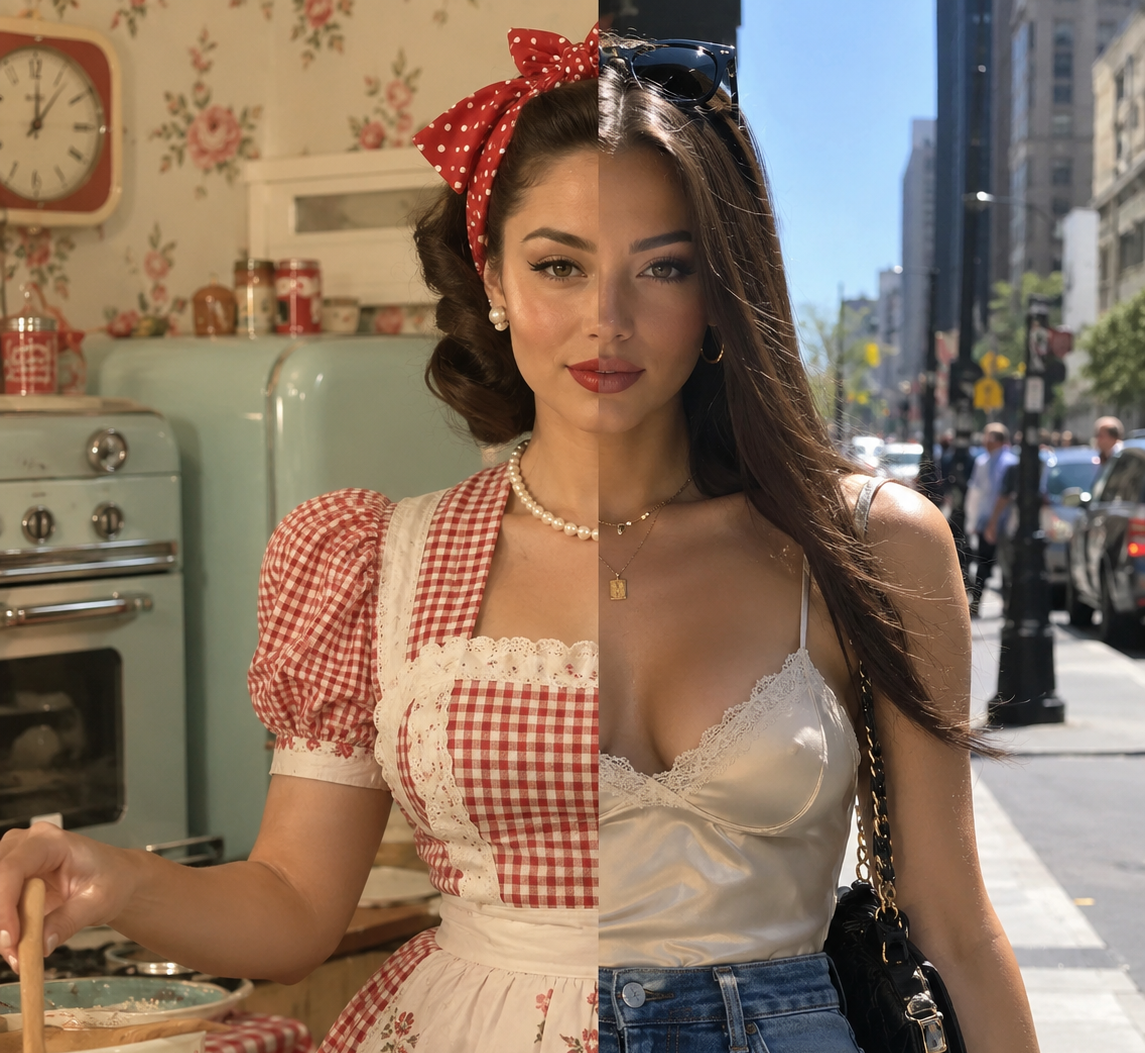


The tradwife movement turned traditional marriage, stay-at-home motherhood and female submission into a powerful social media phenomenon. Now, some of the women who once embraced those ideals are questioning them. Researchers call it “de-tradding,” a growing counter-narrative shaped by divorce, financial dependence, domestic abuse and disillusionment. In the United States, their stories also expose the complicated relationship between conservative Christianity, the MAGA movement and the politics of traditional femininity.
For years, the tradwife movement offered American women a carefully curated vision of domestic happiness, complete with homemade bread, vintage dresses, large families and husbands who provided financial security. On TikTok, Instagram and YouTube, these images appeared to promise an escape from demanding careers, economic insecurity and the pressure to balance motherhood with professional ambition.
But behind the nostalgic imagery was sometimes a much more explicit ideology: a belief that men and women have fundamentally different roles, that husbands should lead their families and that wives should embrace submission as an expression of femininity, faith or marital devotion.
Now, some women who once embraced that worldview are publicly distancing themselves from it, while others are recounting the personal consequences of living according to its expectations.
In April 2026, psychologists Veronica Hopner and Sophia Sykes of Massey University published a study in Psychology of Women Quarterly identifying this phenomenon as “de-tradding.” Drawing on 24 accounts, the researchers found that women were rejecting the tradwife identity in two different ways: some continued living traditionally but rejected the political or commercial associations of the label, while others abandoned the lifestyle itself, frequently after experiencing domestic violence, infidelity or unequal power relationships.
Their findings challenge one of the most recognizable lifestyle movements to emerge from America’s conservative online culture.
Why Are Women Leaving the Tradwife Movement?
The first important distinction is that not every woman who rejects the tradwife label is abandoning traditional marriage, motherhood or religion. Some continue to homeschool their children, manage their households and embrace conservative Christian values, but object to having those choices associated with a social media identity that has become increasingly commercialized and politicized.
Others describe a much more difficult transition, in which leaving the traditional-wife lifestyle involves separating from a spouse, rebuilding financial independence or reconsidering religious beliefs that once shaped their understanding of marriage.
Hopner and Sykes describe these different experiences as rejecting the “Trad-label” and rejecting the “Trad-life.” Their research, based on social media material and interviews collected between January and June 2025, does not establish how widespread either form of de-tradding is among American women. Instead, it identifies recurring patterns among women who have publicly questioned or left the movement.
The distinction is particularly important because the consequences can be radically different. Rejecting an online label may require little more than changing the way a woman presents herself publicly, while leaving a marriage structured around male authority and financial dependence can involve considerable economic, social and psychological upheaval.
One woman’s experience has become particularly revealing.
Bernadine Bluntly: From Female Submission to Divorce
Bernadine Barber, known online as Bernadine Bluntly, built a following around traditional gender roles and a vision of marriage in which the husband occupied a position of authority.
In 2019, she participated in a right-wing gathering in Miami, where she advocated traditional marital submission and opposed women’s voting rights. Her views went considerably further than the domestic nostalgia usually associated with tradwife videos, making her a particularly visible example of the movement’s explicitly political wing.
By 2026, however, Barber’s life had changed dramatically.
A mother of six, she left her marriage in May 2025 and subsequently obtained a domestic-violence protection order in Missouri. Her former husband denied allegations of abuse. Barber now publicly describes herself as a survivor of domestic violence and has distanced herself from the ideology she once promoted.
Her story was examined in September 2026 by journalist Amanda Hess in The New York Times, drawing attention to the profound contradiction between an online identity built around marital submission and the reality of leaving a marriage.
For Barber, the break was not simply a matter of changing political opinions. It also involved rebuilding a personal identity that had long been defined by her role as a wife and by the conviction that traditional marriage represented a woman’s highest achievement.
Her experience is one individual account, not evidence that the tradwife lifestyle necessarily leads to abuse. Nevertheless, it illustrates why researchers increasingly view de-tradding as a process that can involve personal, economic and ideological transformation.
Tia Levings: Escaping Religious Fundamentalism and Reclaiming Independence
Another important voice is Tia Levings, the American author of A Well-Trained Wife: My Escape from Christian Patriarchy, published in 2024.
Levings recounts her experiences within a fundamentalist Christian environment where obedience to male authority shaped expectations surrounding marriage, motherhood and women’s independence. Her account describes how religious teachings about submission influenced her understanding of what a wife should accept, including circumstances in which leaving a relationship could be presented as a failure of faith.
Her testimony also appears in Hopner and Sykes’s 2026 research, where the authors examine the difficulties faced by women whose education, careers and personal identities were constrained by patriarchal religious expectations.
Levings’s experience is particularly important because it highlights the difference between the polished digital presentation of traditional femininity and the more restrictive environments in which similar beliefs may be lived.
Although her experiences predate the current social media trend, they help explain why some women who encounter the tradwife movement online may underestimate the consequences of making male authority central to their personal and financial lives.
For women leaving these environments, independence can require more than finding employment. It may also mean rebuilding friendships, reconsidering religious teachings and learning to make decisions that were previously expected to belong to their husbands.
Tradwives, MAGA and the Religious Right: How the Movement Became Political ?
The tradwife phenomenon cannot be reduced to the Republican Party or Donald Trump’s MAGA movement, but research shows that some of its most ideological participants occupy overlapping conservative political spaces.
In a 2024 study published in the Journal of Contemporary Ethnography, Sophia Sykes and Veronica Hopner examined 36 tradwife-related social media profiles, most of them based in the United States, and identified three ideological categories: 17 Conservative Right profiles, 10 Alt-Lite profiles and nine Alt-Right profiles.
The researchers selected accounts exhibiting conservative or far-right affiliations, meaning these figures should not be interpreted as representative of all women who identify as tradwives.
Their findings nevertheless demonstrate the ideological range within the political tradwife subculture, from Republican supporters and conservative Christians to white nationalists and other extremist figures.
The movement’s political connections become particularly visible through organizations such as Turning Point USA, the conservative activist network founded by Charlie Kirk.
At its Women’s Leadership Summit in San Antonio in June 2026, approximately 3,000 women attended an event bringing together conservative activism, Christian identity and traditional family values. The gathering featured Erika Kirk, alongside an environment in which anti-abortion organizations, the Heritage Foundation and businesses promoting Christian lifestyles or fertility-related products were represented.
The event demonstrated how conservative women’s identity can become a vehicle for political mobilization, particularly among younger voters.
This does not mean every attendee supported the tradwife movement or that all tradwives identify with MAGA. It does show how the language of femininity, faith, motherhood and family increasingly circulates within a wider conservative political infrastructure.
The ideological overlap is also visible in the Republican Party’s emphasis on marriage, children and religious liberty, and in Vice President JD Vance’s public advocacy of higher birth rates and stronger family formation.
Yet promoting marriage or parenthood is not the same as endorsing female submission. The important distinction is between political support for family life and the more hierarchical conception of gender promoted by certain tradwife influencers.
Estee Williams and the Biblical Case for Female Submission
Religion is central to understanding why the tradwife movement resonates with some American audiences.
Estee Williams, one of the most recognizable tradwife influencers, has built her public identity around an idealized version of 1950s domestic femininity, combining vintage fashion, homemaking and a traditional division of responsibilities within marriage.
Unlike lifestyle creators who simply share domestic routines, Williams has explicitly connected her marital philosophy to Christian teachings, invoking biblical passages about wives submitting to their husbands.
Her position reflects a broader theological tradition known as complementarianism, according to which men and women possess equal spiritual worth but are assigned different responsibilities, with husbands exercising leadership within marriage.
This interpretation is influential in parts of American evangelical Christianity, although many Christian communities reject hierarchical understandings of marriage.
The connection between religion and conservative politics is also significant. According to Pew Research Center’s 2023–2024 Religious Landscape Study, 80% of White evangelical Protestants identified with or leaned toward the Republican Party.
That figure describes a religious population, not tradwife influencers. Nevertheless, it helps explain why traditional gender teachings and Republican political culture frequently intersect in American public life.
For some women, however, leaving the tradwife identity does not mean rejecting Christianity. Hopner and Sykes found that certain religious women explicitly rejected the commercialization of biblical femininity, arguing that faith should not be reduced to vintage clothing, baking videos or an influencer brand.
Their criticism was directed not at homemaking itself, but at the suggestion that a particular social media aesthetic represented the only authentic way to live as a Christian woman.
The Financial Contradiction Behind the Tradwife Influencer Economy
Perhaps the most revealing contradiction within the tradwife movement concerns money.
The traditional arrangement promoted by many influencers assigns the husband the responsibility of earning income while the wife concentrates on homemaking and childcare. Yet the women promoting this lifestyle online may themselves operate successful businesses, producing videos, developing audiences, negotiating sponsorships and monetizing their personal brands.
The distinction between the influencer and her followers can therefore be substantial.
A creator who earns money from advertising or partnerships may possess financial resources and professional experience that are unavailable to a woman who leaves paid employment entirely in order to follow the lifestyle being promoted.
Sykes and Hopner identified this commercialization of traditional femininity in their 2024 research, observing how women transformed conservative gender ideologies into marketable digital identities.
This does not mean all tradwife influencers are wealthy or that every stay-at-home mother is financially vulnerable. Household finances depend on income, savings, property ownership, legal protections and the arrangements couples establish.
But the contradiction raises an important question: what happens when the woman selling the image of financial dependence is economically independent because she sells it?
For women without independent resources, the end of a marriage can create immediate practical difficulties, particularly after years outside the workforce. Returning to employment may require new qualifications or childcare arrangements, while rebuilding savings and retirement security can take considerably longer.
Financial dependence is not necessarily evidence of coercion, but it can reduce the options available to someone attempting to leave an unequal or abusive relationship.
Why De-Tradding Challenges the Traditional-Wife Ideal ?
The emergence of de-tradding does not prove that the tradwife movement is disappearing. Nor does it mean that women who prefer homemaking or traditional marriages are inevitably dissatisfied.
What the research documents is a growing visibility of women questioning the identity, ideology or lived arrangements associated with tradwifery, including women who once embraced them.
Some continue to value motherhood, marriage and religion but reject the idea that those choices must be connected to conservative political branding. Others describe leaving relationships in which the expectation of obedience became difficult to reconcile with their safety, autonomy or financial security.
There is also a broader cultural paradox. Social media platforms helped transform domestic nostalgia into an internationally recognizable aesthetic, allowing very different audiences to encounter the same images without necessarily sharing the same beliefs.
A video showing homemade bread may appeal equally to a progressive mother, a conservative Christian homemaker or someone interested in sustainable living. Yet the political messages attached to similar imagery can vary dramatically.
Hopner and Sykes argue that the rejection of tradwife identities reflects women’s attempts to renegotiate femininity, faith and belonging in an online environment where personal lifestyles are increasingly turned into public brands.
That is what makes de-tradding more than another social media trend.
It brings into public view experiences that the traditional-wife aesthetic rarely emphasizes: the possibility of divorce, the practical consequences of economic dependence, the complexity of religious identity and the unequal distribution of authority within some marriages. For years, the tradwife movement asked whether women should be free to reject professional ambition in favor of marriage and motherhood.
The women now questioning that movement are introducing another dimension to the debate. A choice is not defined only by the freedom to make it. It is also shaped by the freedom to change it.
Sources
- Veronica Hopner and Sophia Sykes, “De-Tradding: Rejection of the Tradwife Label and Rejection of the Tradwife Life,” Psychology of Women Quarterly, April 3, 2026. https://doi.org/10.1177/03616843261437418
- Sophia Sykes and Veronica Hopner, “Tradwives: Right-Wing Social Media Influencers,” Journal of Contemporary Ethnography, April 18, 2024. https://doi.org/10.1177/08912416241246273
- Céline Zünd, “Ex-MAGA, ex-mormone, ex-tradwife,” Le Temps, September 28, 2026.
- Eve Minault, “Servir un mari, Dieu et l’Amérique,” Le Monde, June 21, 2026.
- Tia Levings, A Well-Trained Wife: My Escape from Christian Patriarchy, 2024.
- Pew Research Center, Religious Landscape Study, 2023–2024.