
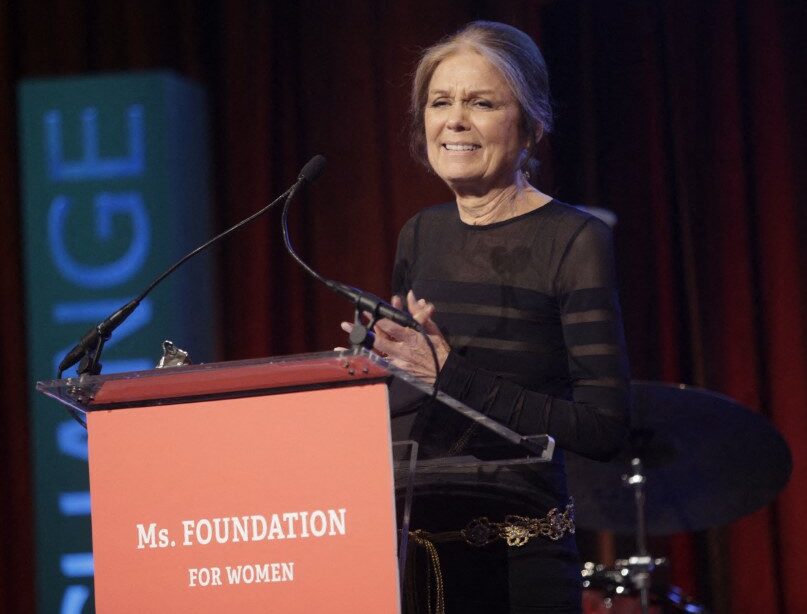


Gloria Steinem, the trailblazing American journalist, feminist activist and co-founder of Ms. Magazine, has died at 92. For more than six decades, she helped transform the way America talked about women, power, politics, abortion, sexual violence and equality — while fighting to give women both a voice in the media and a seat at the table.
Few women have shaped modern American feminism — or feminist journalism — as profoundly as Gloria Steinem.
She understood early that changing laws was not enough. Women also needed to change the stories America told about them, gain access to the media and enter the rooms where political decisions were made.
Her life became a remarkable intersection of journalism, feminism and political activism.
Gloria Steinem’s death at 92 marks the end of a feminist era
Gloria Steinem died at her home in New York at the age of 92, according to her foundation.
Born on March 25, 1934, in Toledo, Ohio, Steinem became one of the most recognizable leaders of the American women’s movement and one of the journalists who fundamentally changed how women’s lives were covered in the United States.
Her influence stretched far beyond feminism itself. She challenged the boundaries between so-called “women’s issues” and mainstream news.
Abortion was political. Domestic violence was political. Equal pay was political. Sexual harassment was political. Women’s representation was political.
Today, that may sound obvious. In the America where Steinem began her career, it was anything but.
1963: Gloria Steinem goes undercover as a Playboy Bunny
One of the defining moments of Gloria Steinem’s journalism career came in 1963.
At 28, she went undercover as a Playboy Bunny at New York City’s Playboy Club for Show magazine.
Her two-part investigation, “A Bunny’s Tale,” exposed what existed behind the glamorous image sold to the public: sexual objectification, strict appearance requirements and difficult working conditions.
The assignment made her famous, but it also revealed the sexism of journalism itself.
Steinem later described struggling to be taken seriously as a reporter after the story. Yet the investigation would become one of the best-known examples of undercover journalism of its era.
More importantly, it foreshadowed the journalism she would practice for decades: going behind the image to document women’s actual experiences.
1969: Abortion and the beginning of a lifelong feminist fight
Another turning point came in 1969, when Steinem attended an abortion speak-out in New York.
Women publicly described their experiences with abortion at a time when the procedure remained illegal in much of the United States.
Steinem knew that reality personally.
At 22, while living in London before traveling to India, she had obtained an abortion. She would later speak openly about it.
Hearing other women tell their stories helped propel her deeper into the emerging women’s liberation movement.
It also reinforced a principle that would define her career: experiences dismissed as private problems could reveal systemic inequality.
Gloria Steinem fought to get women elected
Steinem’s feminism was never limited to media representation.
She wanted women to hold political power.
In 1971, Steinem joined Shirley Chisholm, Bella Abzug, Betty Friedan and other prominent activists in founding the National Women’s Political Caucus.
Its mission was straightforward and transformative: recruit, train and support women seeking elected and appointed office.
This was a pivotal moment.
Women needed the right to speak. They needed journalists willing to tell their stories. But they also needed a seat at the table where laws, budgets and public policies were decided.
Steinem spent decades pushing for greater political representation and supporting women’s participation in American democracy.
1972: Ms. Magazine changes American journalism
If one project symbolizes Gloria Steinem’s impact on journalism, it is Ms. Magazine.
Steinem co-founded the publication in the early 1970s, with its first stand-alone issue appearing in 1972.
It was revolutionary.
At a time when much of the media aimed at women remained centered on beauty, marriage, fashion and domestic life, Ms. treated women as citizens, workers, voters and political actors.
The magazine brought issues including abortion rights, rape, domestic violence, sexual harassment, workplace discrimination and equal pay into mainstream public debate.
It did something deceptively simple but profoundly political:
It took women seriously. And it gave women a platform to tell their own stories.
Steinem remained closely associated with Ms. for years, helping establish a model of feminist journalism that would influence generations of reporters, editors and media founders.
Gloria Steinem understood that representation in the media means power
Steinem’s fight for women’s voices continued long after the height of the second-wave feminist movement.
She helped establish the Ms. Foundation for Women and later co-founded the Women’s Media Center in 2005 with Jane Fonda and Robin Morgan.
The goal was again about power: increasing women’s visibility, authority and representation across media.
Who gets interviewed?
Who is considered an expert?
Who writes the story?
Who decides what makes the front page?
And whose experiences are dismissed as anecdotal, private or unimportant?
These questions remain at the heart of debates about women and journalism today.
From abortion rights to the Equal Rights Amendment: six decades of activism
Gloria Steinem’s activism extended across virtually every major battle of the modern American women’s movement.
She fought for abortion rights and reproductive freedom, the Equal Rights Amendment, equal pay, women’s political representation and an end to violence against women.
Her activism also increasingly embraced an intersectional understanding of inequality, and she worked alongside civil rights leaders and feminist activists from different generations and backgrounds.
Her influence reached the highest levels of American public life.
In 2013, President Barack Obama awarded Gloria Steinem the Presidential Medal of Freedom, the nation’s highest civilian honor.
Yet she continued organizing, speaking and writing well into her later years.
Gloria Steinem’s legacy: journalism can change who has power
Gloria Steinem leaves behind books, organizations, political campaigns and more than six decades of activism.
But one of her most important legacies belongs to journalism.
She understood that visibility is power.
When women are absent from newsrooms, expert panels, political coverage and positions of editorial authority, their experiences can disappear from the public conversation.
Steinem spent her career doing the opposite: making women visible.
She helped turn experiences once dismissed as personal into major political issues. She helped women tell their own stories. She helped create media institutions where those stories could be published. And she fought to ensure women could move from being discussed by political institutions to actually leading them.
Her battles remain strikingly current in America.
More than half a century after the creation of Ms., the United States is still debating abortion rights, the Equal Rights Amendment remains unratified as part of the Constitution amid continuing legal and political disputes over its status, women remain underrepresented in many positions of political and corporate power, and sexism and gender-based violence remain deeply rooted.
That is why Gloria Steinem’s work belongs not only to the history of American feminism.
It belongs to the history of American journalism and American democracy.
She spent her life fighting for women to have a voice, a platform and a seat at the table.
The Women’s Voices humbly carries forward the legacy of her decades-long fight to make women’s voices heard.
Thank you, Gloria. So long.