
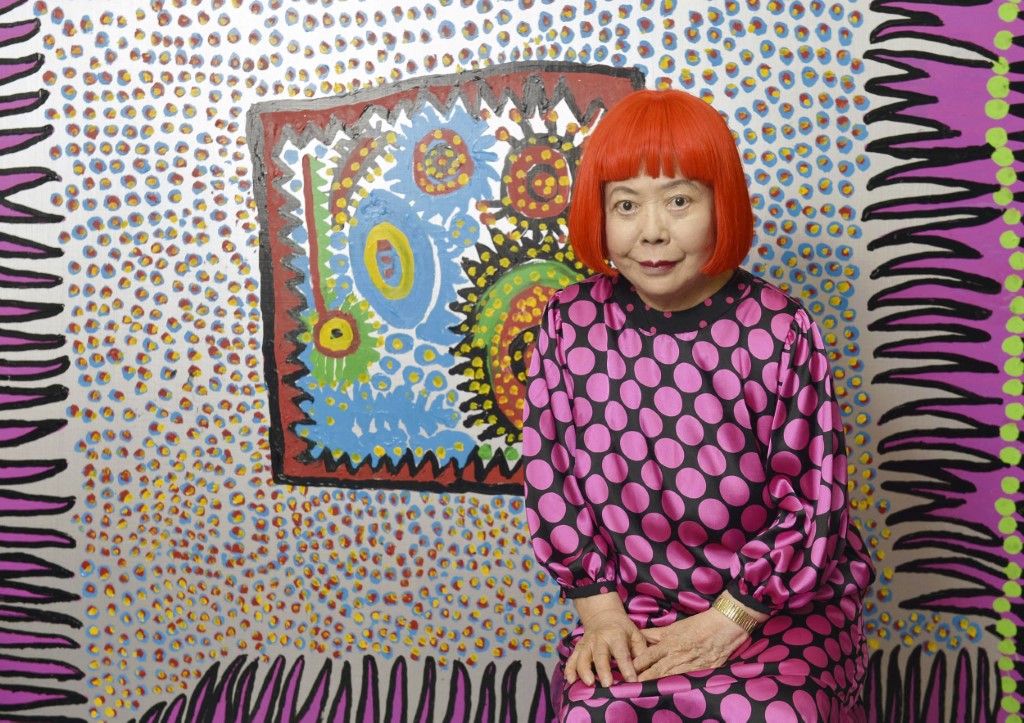


Yayoi Kusama has died at the age of 97. Known around the world for her polka dots, pumpkins and mesmerizing “Infinity Mirror Rooms,” the Japanese artist leaves behind more than eight decades of groundbreaking work. Long marginalized in an art world dominated by men, this pioneer of the New York avant-garde eventually became one of the most famous and highly valued contemporary artists in the world.
Yayoi Kusama wanted to cover the world in polka dots. She very nearly succeeded. The Japanese artist, whose immersive installations have drawn enormous crowds to museums around the world, died on August 14, 2026, at a hospital in Tokyo, aged 97. Her death was announced on August 27 by her studio and the Yayoi Kusama Museum, which emphasized that she had continued painting until the final days of her life.
Behind the yellow pumpkins covered in black dots, the mirrored rooms and the instantly recognizable figure of the petite woman with a red wig lies a story far more complex than that of a contemporary art superstar. A painter, sculptor, performance artist, writer and poet, Yayoi Kusama was a Japanese woman trying to make her mark in the overwhelmingly male New York art scene of the 1960s, an experimental artist whose ideas anticipated aspects of Pop Art, a peace activist who took to the streets to protest the Vietnam War, and later an artist who was largely forgotten before achieving extraordinary international recognition.
Her story is also one of vindication: a woman who lived long enough to see the art world finally recognize the importance of a body of work she had begun developing decades earlier.
Yayoi Kusama: A Childhood in Japan Shaped by Hallucinations and Polka Dots
Yayoi Kusama was born on March 22, 1929, in Matsumoto, a mountainous city in Nagano Prefecture, into a prosperous family involved in the seed business. Her childhood was marked by a difficult family environment and by hallucinatory experiences that she would later describe extensively. Plants appeared to speak to her, flowers and patterns on tablecloths multiplied until they seemed to invade her surroundings, while shapes repeated before her eyes to the point that she felt she herself was disappearing into the environment.
Rather than trying to escape these visions, Kusama gradually transformed them into an artistic language. She drew what she saw, reproduced shapes and repeated them until they saturated the surface. Dots, nets, flowers and, later, pumpkins became far more than decorative motifs: they offered a way of controlling through art what had once frightened her.
Her vocation, however, met with opposition from her family, particularly her mother, who did not envision an artistic career for her daughter. In Japan at the time, a young woman from a prosperous family was more likely to be expected to marry than to pursue an independent life as an artist. Kusama persisted, studying traditional Japanese painting in Kyoto after World War II before quickly rejecting an academic system whose rules she found too restrictive.
Her ambitions were already focused beyond Japan, and particularly on the United States.
Georgia O’Keeffe Helped Yayoi Kusama Look Toward America
One of the most important relationships in Kusama’s early career began from thousands of miles away. Fascinated by the work of Georgia O’Keeffe, Kusama wrote to the American painter and sent her several drawings. O’Keeffe responded, encouraged her and offered advice on how she might establish herself in the United States.
Their correspondence helped convince Kusama that another kind of career was possible. She eventually left Japan for the United States in the late 1950s and settled in New York, where she would remain until 1973.
The contrast was enormous. The young Japanese artist arrived in one of the world’s art capitals at a moment when Abstract Expressionism still dominated the American scene. Jackson Pollock and Willem de Kooning had transformed painting, while a new generation including Andy Warhol, Claes Oldenburg and Donald Judd was preparing to redefine the avant-garde once again.
Among these predominantly male and Western artists, Kusama faced multiple barriers: she was a woman, a Japanese immigrant and had very limited financial resources. She later described years of severe hardship, working with extraordinary intensity in poorly heated studios and sometimes struggling to afford enough food.
Yet this outsider position did not prevent her from developing a profoundly original artistic vocabulary.
The “Infinity Nets”: Yayoi Kusama’s First Artistic Revolution
In the late 1950s, Yayoi Kusama began producing her celebrated Infinity Nets, vast canvases covered with countless tiny hand-painted loops. As the forms repeat, they seem to dissolve the surface of the painting and create a potentially infinite space.
When she exhibited these works in New York in 1959, they quickly attracted attention. Donald Judd, then an art critic before becoming one of the leading figures of American Minimalism, was among those who recognized the significance of her work early on.
Kusama occupied a territory that was difficult to classify. Her art was in dialogue with Abstract Expressionism while anticipating certain developments in Minimalism and Pop Art. While “action painting” celebrated the spectacular physical gesture of the artist, she responded with the methodical, almost obsessive repetition of thousands of tiny forms.
Her ability to work for hours, sometimes days, across enormous surfaces would become one of the defining characteristics of her practice. Repetition enabled her to give visual form to infinity while simultaneously translating the hallucinations she had experienced since childhood.
Yayoi Kusama Before Andy Warhol: Repetition, Accumulation and Allegations of Plagiarism
During the 1960s, Kusama pushed her exploration of accumulation even further. She collected furniture, shoes and everyday objects and covered them with hundreds of phallic protrusions made from stuffed fabric. These Accumulation Sculptures transformed domestic objects into strange forms that were simultaneously unsettling, sexual and absurd.
The question of whether some of Kusama’s experiments preceded those of male artists who would become far more famous later became an important part of the narrative surrounding her career. Kusama notably accused Andy Warhol of appropriating the principles of repetition and accumulation that she had explored in her own installations. She also voiced similar grievances regarding Claes Oldenburg.
These claims remain debated among art historians and should not be presented as established historical fact. They nevertheless highlight a broader reality: within the American avant-garde of the 1960s, innovations by women and minority artists did not always receive the same institutional or commercial recognition as those of their male counterparts.
Kusama was at the heart of that scene. Yet when the history of Pop Art began to be written, it was overwhelmingly male names that came to dominate the narrative.
“Infinity Mirror Rooms”: How Yayoi Kusama Created Her Own Infinity
In 1965, Kusama took another decisive step with Infinity Mirror Room – Phalli’s Field. Inside an environment entirely covered in mirrors, hundreds of white phallic forms decorated with red dots appeared to multiply endlessly. Visitors no longer simply looked at an artwork: they entered it and saw their own bodies absorbed into the installation.
The concept was remarkably innovative. By using mirrors to erase the physical boundaries of the space, Kusama materialized the idea of infinity that was already present in her paintings. The individual ceased to be the center of the world and became one form among thousands.
These installations eventually evolved into the celebrated Infinity Mirror Rooms, which would turn Kusama into a global phenomenon several decades later. Their extraordinary popularity in the age of social media is sometimes associated with Instagram, yet Kusama had conceived these immersive environments almost half a century before smartphones appeared.
Her ability to anticipate our contemporary relationship with images helps explain the remarkable modernity of her work.
Naked Bodies, Polka Dots and the Vietnam War: Yayoi Kusama’s Political Art
Kusama soon moved beyond the confines of galleries. From the mid-1960s onward, she staged performances and happenings in public spaces across New York. In Central Park, near Wall Street and outside major cultural institutions, participants undressed while their bodies were covered in polka dots.
These performances combined sexual liberation, challenges to social conventions and opposition to the Vietnam War. Kusama used her distinctive visual language as a political instrument: the dotted body became simultaneously an artwork, a vehicle for protest and a symbol of the “self-obliteration” at the heart of her artistic philosophy.
She even addressed Richard Nixon, then a presidential candidate, in a provocative performance letter in which she symbolically offered her body in exchange for an end to the Vietnam War. Behind the provocation was an artist deeply committed to pacifism, who maintained throughout her life that art could offer a response to violence.
This political dimension of her work is sometimes overshadowed today by the enormous commercial success of her pumpkins and polka dots. Yet the Kusama of the 1960s was a radical artist who used nudity, sexuality and public space to challenge conservative America.
“My Life Is a Dot”: Self-Obliteration at the Heart of Kusama’s Art
Reducing Yayoi Kusama’s polka dots to a visual trademark would therefore miss the essential meaning behind them. They are closely connected to a fundamental concept in her work: self-obliteration, the symbolic disappearance of the individual through repetition.
In her paintings and installations, one dot joins another, then hundreds and eventually thousands. The boundaries between the body, the object and the surrounding environment gradually disappear. The viewer is ultimately absorbed into the same proliferation.
What had been a source of anxiety during her childhood thus became an artistic method. Kusama did not simply attempt to represent her hallucinations: she organized and reproduced them, eventually inviting the entire world to step inside them.
The relationship between artistic creation and mental health would remain inseparable from her biography, although reducing her immense body of work to her psychological experiences alone would be deeply simplistic.
Yayoi Kusama’s Return to Japan and Her Voluntary Life in a Psychiatric Hospital
After 16 extraordinarily intense years in the United States, Yayoi Kusama returned to Japan in 1973. She went through a difficult period marked by depression and the persistence of her hallucinations.
Several years later, she voluntarily entered a psychiatric hospital in Tokyo, where she would continue to live for decades while traveling almost daily to a studio nearby. This unusual arrangement allowed her to maintain an exceptional pace of artistic production over the following decades.
Kusama did not stop creating during this period. She painted, drew, wrote novels and produced poetry. Her international profile, however, declined sharply, and the artist who had once been part of the New York avant-garde seemed for a time to disappear from the dominant narrative of contemporary art.
That made her eventual rediscovery all the more remarkable.
Yayoi Kusama’s Late Triumph and the Venice Biennale
From the late 1980s onward, Western institutions began reassessing Kusama’s work. A New York retrospective in 1989 played an important role in her rediscovery, but it was above all her participation in the 1993 Venice Biennale, where she officially represented Japan, that marked her major return to the international stage.
Her mirrored installations, pumpkins and repetitive patterns were rediscovered by a new generation of critics, curators and collectors. Major international institutions began organizing exhibitions of her work, while her Infinity Mirror Rooms became extraordinary public successes.
The reversal was striking. The young Japanese immigrant who had experienced poverty in New York gradually became a major figure in the history of contemporary art. Her longevity also played a role in this late recognition: Kusama lived long enough to witness a new generation of art historians reassess the place of women in the artistic movements of the 20th century.
Her career became emblematic of a much broader phenomenon: the rediscovery of women artists whose importance had been minimized, only to be reevaluated decades later.
From Kusama’s Pumpkins to Louis Vuitton: When an Artist Becomes a Global Icon
From the 2000s onward, Yayoi Kusama’s universe expanded far beyond museum walls. Her monumental polka-dotted pumpkins became as famous as her mirrored rooms, while her own appearance — red wig, brightly colored clothes and repetitive patterns — contributed to an instantly recognizable public identity.
In 2012, her collaboration with Louis Vuitton and Marc Jacobs brought her polka dots into the global luxury industry. Bags, clothes, shoes and store windows were covered with her motifs. A new collaboration launched in 2023 led to a spectacular international campaign, transforming the façades of Louis Vuitton stores into Kusama-inspired installations.
The commercialization of her visual universe sometimes attracted criticism. The provocative, anti-war artist of the 1960s had, half a century later, become one of the most commercially powerful signatures in contemporary art.
Yet this paradox also illustrates the scale of her extraordinary comeback. The young Japanese artist who had once struggled to sell her paintings in New York eventually imposed her visual language on the walls of the world’s greatest museums and the windows of international luxury houses.
Yayoi Kusama Became One of the World’s Most Expensive Women Artists
Institutional recognition was accompanied by a spectacular rise in Kusama’s value on the international art market. In November 2014, White No. 28, a 1960 painting from her Infinity Nets series, sold for approximately $7.1 million at Christie’s in New York. At the time, the sale made Yayoi Kusama the most expensive living woman artist at auction.
Her works would continue to sell for millions of dollars, establishing her as one of the most highly valued women artists on the international market.
The financial dimension of her career is significant. Historically, the art market has undervalued works created by women, who remain dramatically underrepresented among the world’s highest auction records. Kusama’s journey from poverty during her early American years to multimillion-dollar auction sales therefore represents one of the most dramatic reversals in her career.
Recognition came late, but when it arrived, it was immense.
Yayoi Kusama: A Woman Decades Ahead of Her Time
It is difficult to confine Yayoi Kusama to a single artistic movement because her work intersected with so many of the major transformations of the second half of the 20th century. Her Infinity Nets engaged with abstraction and Minimalism; her accumulations anticipated aspects of Pop Art; her soft sculptures transformed everyday objects; her happenings contributed to the history of performance art; her polka-dotted bodies foreshadowed aspects of body art; and her mirrored rooms created an immersive experience that has become central to contemporary art.
Her career also forces us to reconsider the history of the American avant-garde and to ask who was granted recognition — and who was not. Kusama worked alongside male artists who became towering figures in art history, but she had to wait decades before receiving comparable acclaim.
Over the course of her life, she experienced almost every possible position within the art world: a young girl discouraged from painting, an impoverished immigrant artist in New York, an underground figure, a peace activist, an overlooked creator, a voluntary resident of a psychiatric hospital, a rediscovered artist, a museum superstar, a social-media phenomenon, a collaborator with luxury fashion houses and finally one of the most highly valued women artists on the planet.
Yayoi Kusama Continued Painting Until Her Final Days
Yayoi Kusama devoted more than eight decades of her life to creation. In the statement announcing her death, her studio emphasized this absolute commitment to art: despite her age, she was still painting during the final days of her life.
That perseverance perhaps reveals more about the scale of her achievement than any auction record. Kusama transformed the visions that had frightened her as a child into a universal visual vocabulary. She turned hallucinations into architecture, repetition into an aesthetic, mirrors into an experience of infinity and an ordinary pumpkin into one of the most recognizable images in contemporary art.
Above all, her career tells the story of a long struggle for a place that was never guaranteed to her. As a woman, a Japanese artist and a foreigner in the New York art scene of the 1960s, she watched many of her male contemporaries achieve fame before she did. Decades later, visitors queued around museums to see her exhibitions and her paintings sold for millions of dollars.
The “princess of polka dots” ultimately achieved the extraordinary ambition that ran throughout her work: to dissolve boundaries beneath an infinity of dots and, in her own way, cover the world in polka dots.