
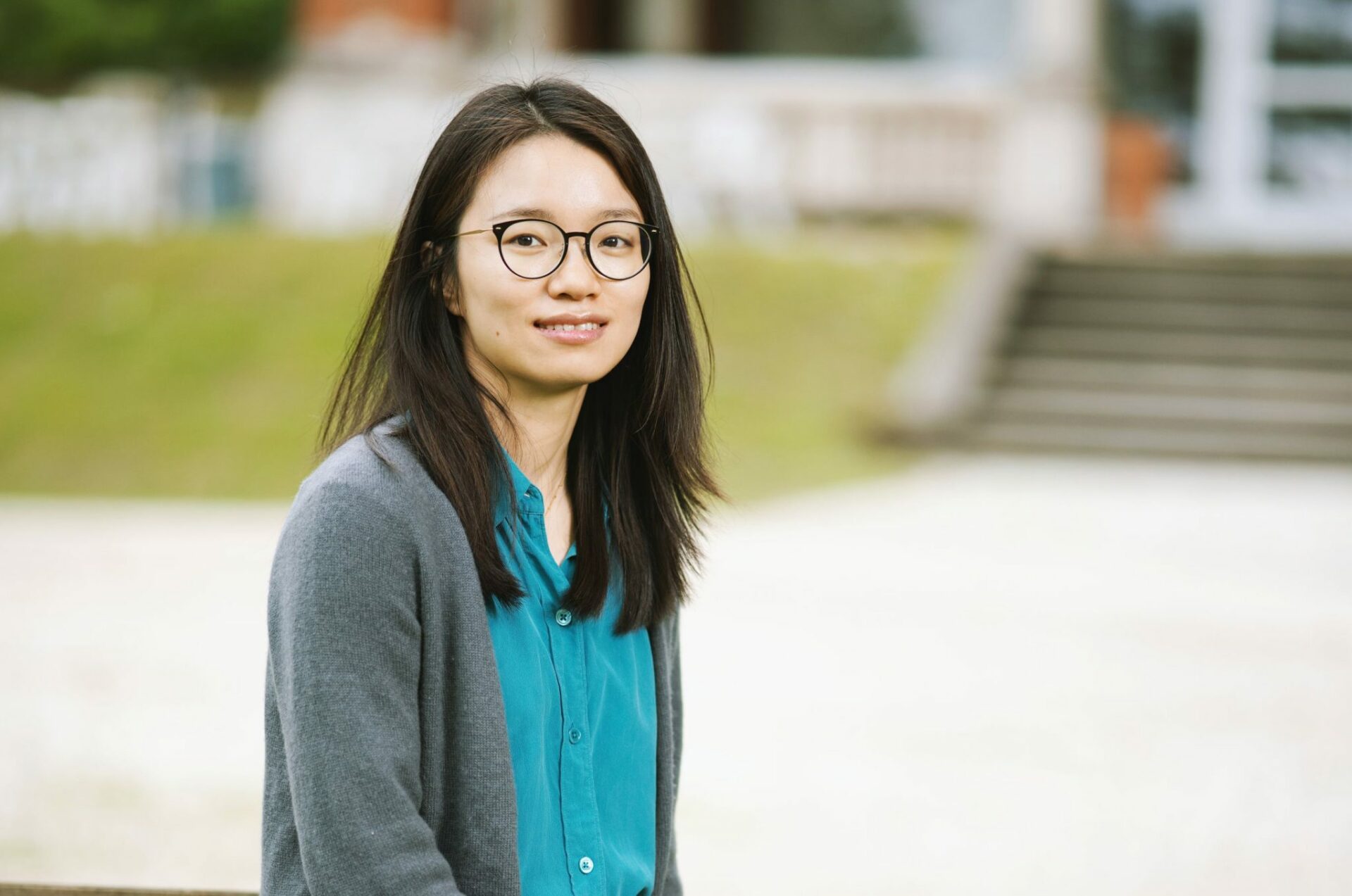


At just 35 years old, Hong Wang has entered the history of mathematics. The Chinese mathematician, a permanent professor at the Institut des Hautes Études Scientifiques (IHES) in France and a professor at New York University, has been awarded the 2026 Fields Medal, the world’s highest honor in mathematics. Often described as the “Nobel Prize of Mathematics,” the award is presented every four years by the International Mathematical Union to researchers under the age of 40 whose work has profoundly advanced the field.
Beyond its scientific significance, Hong Wang’s recognition is also a milestone for women in STEM. She becomes only the third woman ever to receive the Fields Medal since the prize was established in 1936, following Iranian mathematician Maryam Mirzakhani in 2014 and Ukrainian mathematician Maryna Viazovska in 2022. Her achievement is both a personal triumph and a powerful reminder of the progress—and the challenges—that remain for women in mathematics.
Why Did Hong Wang Win the Fields Medal?
Hong Wang was honored for a body of work that has transformed harmonic analysis, one of the most sophisticated branches of modern mathematics. Harmonic analysis explores waves, oscillations, frequencies, geometric structures and partial differential equations, providing essential tools for understanding both abstract mathematics and many phenomena in physics.
The Fields Medal committee recognized her groundbreaking contributions to three of the discipline’s most difficult problems: the Fourier Restriction Conjecture, the Local Smoothing Conjecture, and above all the Kakeya Conjecture, a question that has challenged mathematicians for more than a century.
Rather than solving a single isolated problem, Hong Wang developed new mathematical techniques that are reshaping entire areas of analysis and geometry. Her work is already influencing numerous branches of pure mathematics and is expected to guide future research for decades.
The Kakeya Conjecture: Solving One of Mathematics’ Greatest Challenges
The Kakeya problem appears surprisingly simple.
In 1917, Japanese mathematician Soichi Kakeya asked what is the smallest possible region in which a line segment—or, more simply, a pencil—can rotate through a complete 360-degree turn.
Behind this intuitive question lies one of the deepest problems in modern mathematics.
Together with mathematician Joshua Zahl, Hong Wang announced a proof of the three-dimensional Kakeya Conjecture, a breakthrough many experts consider one of the most important mathematical achievements of the decade. Their proof, extending over more than one hundred pages, establishes fundamental new results connecting geometry, harmonic analysis and Fourier analysis.
The importance of this discovery extends far beyond the Kakeya problem itself. The techniques developed by Hong Wang are expected to influence research on partial differential equations, geometric measure theory, Fourier analysis and several other central areas of mathematics.
For many specialists, her work represents a fundamental shift in how some of mathematics’ most difficult problems can now be approached.
An International Career Between China, France and the United States
Born in China, Hong Wang has built an exceptional international academic career.
After studying at Peking University, she continued her education at École Polytechnique and Université Paris-Saclay before earning her PhD at the Massachusetts Institute of Technology (MIT) under renowned mathematician Larry Guth.
Following appointments at several leading institutions, she joined the Institut des Hautes Études Scientifiques (IHES) in France as a permanent professor while also serving as a professor at New York University.
Long before receiving the Fields Medal, Hong Wang had already established herself as one of the world’s leading young mathematicians. Her previous honors include the Maryam Mirzakhani New Frontiers Prize (2022), the Salem Prize (2025), the Ostrowski Prize (2025), and the Clay Research Award (2026), distinctions that positioned her among the strongest candidates for the Fields Medal.
Only Three Women Have Won the Fields Medal Since 1936
Hong Wang’s achievement also highlights the persistent gender gap in mathematics.
Since the Fields Medal was first awarded nearly 90 years ago, only three women have received the discipline’s highest honor:
- Maryam Mirzakhani (Iran) – 2014
- Maryna Viazovska (Ukraine) – 2022
- Hong Wang (China) – 2026
This statistic reflects not a shortage of female talent but decades of structural inequalities affecting academic careers, research funding, leadership opportunities and international recognition.
Although women’s participation in STEM has steadily increased worldwide, they remain significantly underrepresented in pure mathematics, particularly in senior academic positions and among recipients of the field’s most prestigious awards.
The visibility of mathematicians such as Hong Wang is therefore essential. Research consistently shows that female role models encourage more girls and young women to pursue advanced scientific studies while helping dismantle long-standing gender stereotypes.
Mathematics Enters the Age of Artificial Intelligence
The 2026 Fields Medal arrives at a pivotal moment for mathematics.
Artificial intelligence is rapidly transforming mathematical research. Advanced AI systems are increasingly capable of generating sophisticated mathematical proofs, opening exciting new possibilities while also raising important questions about reliability, transparency and scientific verification.
Among this year’s Fields Medal winners, Canadian mathematician Jacob Tsimerman announced that he will join OpenAI, highlighting the growing convergence between fundamental mathematics and artificial intelligence.
Meanwhile, fellow laureate Yu Deng believes AI will become a powerful research partner rather than a replacement for mathematicians.
The debate intensified earlier this year with the publication of the Leiden Declaration, in which leading mathematicians warned that AI-generated proofs may appear convincing while still containing hidden errors. The declaration calls for rigorous safeguards to preserve the integrity of mathematical research as AI becomes increasingly integrated into scientific discovery.
The Four Winners of the 2026 Fields Medal
Alongside Hong Wang, three other outstanding mathematicians received the 2026 Fields Medal:
- Yu Deng (China)
- John Pardon (United States)
- Jacob Tsimerman (Canada)
Together, they represent a new generation of researchers shaping the future of mathematics at a time of profound technological transformation.
A Historic Victory for Mathematics—and for Women in Science
Hong Wang’s Fields Medal is about far more than mathematical excellence.
It demonstrates that women are making groundbreaking contributions in some of the world’s most abstract and demanding scientific disciplines whenever they are given equal opportunities to study, conduct research and lead.
By becoming only the third woman ever to receive the Fields Medal, Hong Wang has not only written a new chapter in the history of mathematics. She has also become an inspiration for countless young women considering careers in STEM, where gender disparities remain significant despite decades of progress.
Her achievement sends a powerful message: scientific excellence has no gender. Yet the recognition of women at the highest levels of science still has a long way to go.